Hollywood musical biopics rarely capture the full complexity of their subjects. The truth is, these films aren’t demanded for the hope of an accurate depiction. They exist to satisfy the public’s appetite for a critical autopsy of an artist’s rise and fall. Their sometimes interpretive—and if need be, unauthorized—exposé.
If we were to dissect an artist’s life truly, we’d have to separate the art from its flawed, imperfect creator. And that is impossible. Because precisely how an artist sees reality is what compels us to elevate them to stardom in the first place. The way they laugh. The way they cry. How they sometimes make unfathomable mistakes. But somehow, they do something impossible—they keep going, keep dreaming aloud, in messy ways you and I wish we dared to. And then, they capture this lightning in a bottle. They put it into their music.
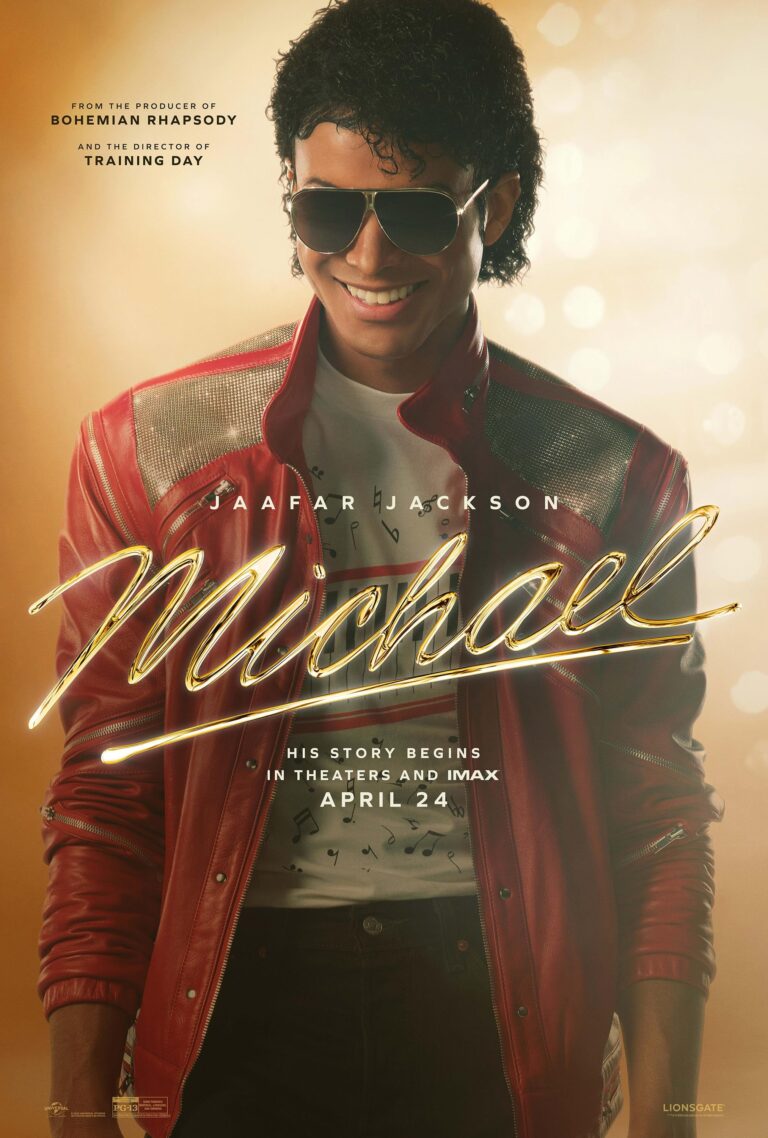
With Michael, director Antoine Fuqua attempts to examine this very aspect. It is an artistic retelling of the life and legacy of Michael Jackson, the most famous man to walk the earth. The film tells the story behind his art, tracing his journey from sensitive child prodigy and lead singer of The Jackson 5 to the late 1980s, focusing on his struggle to break free from an overbearing, abusively flawed father to become “Michael,” the King of Pop Culture.
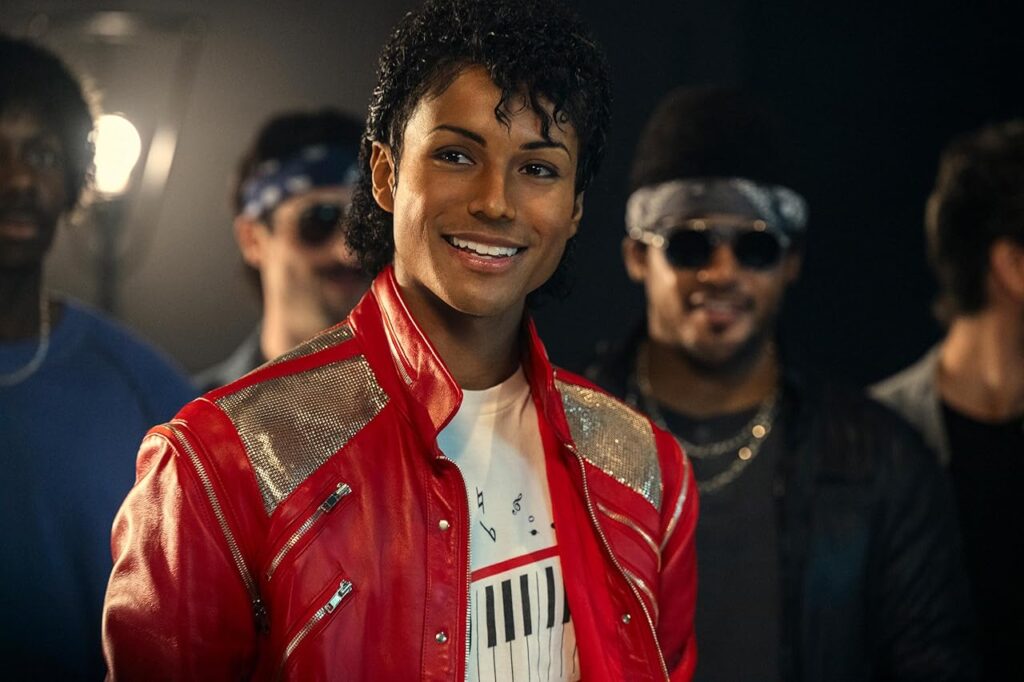
We were supposed to get Fuqua’s, I’ll call it “Man in the Mirror,” cut last year. Originally, it opened with the police raiding Michael Jackson’s home in 1993. Neverland Ranch is his 2,700-acre California estate with an amusement park, a zoo, and a train station. Fuqua told The New Yorker, “I shot [Michael] being stripped naked” and “treated like…a monster.” The allegations? Sexual abuse of a child. Fuqua was actually going to take it there, examine the controversy, and deal with it accordingly. He said that the revised Michael you see—totaling upwards $15 million in reshoots, per Variety—wasn’t the original cut.
As police lights flash behind him, Michael stares at his own reflection, pensive. Michael was later strip-searched, with the examiner examining his genitals in comparison to the accuser’s details.
Derek Luke was actually cast to play attorney Johnnie Cochran in Michael, but his scenes were cut completely due to legal complications regarding the portrayal of the 1993 child molestation accusations. A clause in a legal settlement between the Michael Jackson estate and the accuser’s family prohibited the depiction of Jackson’s accuser, their family, or their story in any estate-authorized projects.
Trying to contribute artistically and intellectually to an American Western canon, shaped by white gaze and norms as a Black American, is an almost impossible task—by design.
Michael Jackson achieved it. He may or may not have needed psychiatric or psychological care. But he did wear the crown of King of Popular Culture. He did not earn that title by committing or not committing one of the worst crimes imaginable. He did not earn it by making the poorest decisions of his life, which was sleeping in the same bedroom with other people’s kids. He was never found guilty of any sexual charges in a court of law, ever. Since some stories have changed, claiming no sexual abuse happened at all. Regardless, it was his art that propelled Michael to unprecedented megastardom. Trying to attach sexual abuse, somehow playing a role in that, is messy. Spectacle. It’s interpretive as the way we humans perceive art itself.
Fuqua chose not to place such a messy burden on a Michael who is no longer here to defend himself. The scrapped “Man in the Mirror” cut wouldn’t have done that anyway, either. Six of Jackson’s biological relatives, including his eldest son, Prince, are executive producers of the project. He was reportedly on set every day to oversee the production. Co-executors to Michael Jackson’s estate, John Branca and John McClain, signed off on it, as well. Branca, portrayed by Miles Teller in Michael, was Jackson’s real-life attorney and key advisor since 1980.
Johnnie Cochran isn’t the only major figure who didn’t make the cut. Michael’s sister, Janet Jackson, wasn’t involved at all. Diana Ross, played by Kat Graham, a pivotal mentor and music industry mother figure, didn’t either. So the film doesn’t spend too much time with the Jackson 5 era. No recreating their time co-starring in the 1978 film The Wiz, either, where Michael played the Scarecrow, and Ross played Dorothy. The final version of Michael was reworked to end in 1988, with a nothing-but-awesome nostalgic time-machine joyride that lasts 127 minutes.
Published in the book The Michael Jackson Tapes: A Tragic Icon Reveals His Soul in Intimate Conversation by Rabbi Shmuley Boteach, Michael himself says, “I am scared of my father to this day.” One day, Joe asked Michael, “Why are you scared of me?” The beatings? The intimidation? Probably being told to shut up unless you’re performing or practicing? Michael said he was paralyzed by trauma and fear in that moment. He couldn’t respond but wanted to say, “Do you know what you have done?” His voice breaking as he recalls the moment: “Do you know what you have done to me?”
There are several moments like these in Fuqua’s Michael, they’re subtle. Nuanced. These aren’t melodramatic breakdowns—they’re flickers of pain, glances, silences, the shadow of a father’s violence looming over a son’s creative genius.
A line from the film that lingers like the specter of a moment that likely happened. It’s when Michael, played by his real-life nephew Jaafar Jackson (Jermaine’s son), tells his father, Joe Jackson, in front of his siblings who formed The Jackson 5, “I need to think,” a reference to his growth as an individual and his future. Joe Jackson, portrayed by Coleman Domingo, responds, “I told you what to think.” It’s subtle, but Domingo acts the hell out of it—that is acting. That’s some of Oscar-nominated writer John Logan’s best work, as he did for Gladiator. That is good directing. This is what the film Michael is. This is what it is about. The most famous man to ever walk this earth, known for his voice, was silently fighting the greatest battle of his life.
In real life, shortly after 1988, were among the most creative years of Michael’s life. Michael was an extraordinary Black American. Proudly. In my own childhood, I’d seen him transform into a black panther after the LAPD beat Rodney King. He transformed into a bulletproof, otherworldly sports car when being shot at by evil grown-ups. He willed himself to become a chromed-out fighting machine that rivaled Cybertronians.
In Moonwalker: the big bad grown-up—always an authority, always a threat—beats a helpless child, tells her to shut up, and collars her up. Michael, beaten by the same big bad grown-up as a hundred soldiers have him at gunpoint, feels helpless again. But then, a shooting star races across the sky: Keep going! Keep dreaming aloud, in the messy ways we wish we dared. He transforms, not into a victim, but into an unstoppable machine.
That was Michael’s message to us millennials. But more importantly, that was his message to Joe, in a language that only Joe could understand. Shut up unless I’m performing? Okay. [Insert Michael’s guttural, sustained expression of unapologetic pain, frustration, and rage, here, “Aaaaaah!”] Now imagine being a helpless child, Michael, without that hero. Scary, right? Psychoanalytically frightening. That’s what Newman’s script for Moonwalker—and now, Fuqua’s 2026 theatrical cut of Michael—gets at.
Like the unspoken friction between Joe Jackson and Berry Gordy (portrayed by Lorenz Tate). He’s the record executive, producer, songwriter, and film and television producer, best known for founding Motown Records. It’s one of the most successful Black-owned businesses in America. He’s the man responsible for introducing Michael, the magical music child prodigy, to the world.
When Michael asks Gordy what a button on the studio equipment does, Gordy is patient. It’s presented as a powerful metaphor, a father figure who mentors Michael. He tells him it has to do with the equalizer, “EQ.” Mix and master your own destiny. Joe can’t intimidate and control Michael in Gordy’s studio or the music he makes now, as he did in the shadows. Keep going, keep dreaming aloud. Before Joe takes Michael from the studio, “In here, Michael, there are no wrong questions,” says Gordy. “You can ask me anything, anytime. That’s how we find the magic.” That wasn’t just for Michael. It was Gordy’s pointedly poetic way of confronting Joe, in those same abusive shadows he took Michael to.
Kendrick Sampson, who portrayed “Nathan, the barber” on HBO’s Insecure, transforms into an uncanny likeness of Quincy Jones. In his brief screen time, he conveyed much of the father-mentor relationship he had with Michael as well. Jones is the composer and producer who’s behind “Off the Wall,” “Bad,” and the best-selling album in American history, “Thriller.”
Then there’s Deon Cole as Don King, as Don King! Deon Cole! Hilarious without even trying, stars on a sitcom Black-ish with Tracee Ellis Ross, Diana Ross’s daughter. If you’re familiar with his stand-up, you’ll notice his eyes have a mischievous, knowing look before he lands his funniest jokes ever. This works well for his portrayal of Don King as he meets with Joe “in the shadows.” King met with Joe without Michael’s knowledge to create the Victory Tour with the Jackson Five. Michael didn’t want to do it. When Michael later confronts Joe, he’s paralyzed with that fear again. We hear that haunting line play in Michael’s head, “I told you what to think.” This time, Michael transforms into the unstoppable machine we know.
I live in New York City, and my viewing of Michael had white, Hispanic, and Arab millennials and Gen Xer parents with their Gen Z kids, singing and dancing the whole 127 minutes. Undoubtedly, English was their second language—they knew Michael’s songs word for word. They applauded loudly when Michael told real-life CBS Records president Walter Yetnikoff, played by actor Mike Myers, that he was proudly Black and it’s in his music. It’s a memorable scene discussing MTV’s once ubiquitously white policy, part of a larger systemic issue—by design—of telling everyone what to think about Black Americans. Jaafar Jackson (playing Michael Jackson) and Miles Teller (playing lawyer John Branca) weren’t hearing it. They tasked Yetnikoff on the spot with getting MTV to play Michael’s videos. Yetnikoff threatened to pull his company’s impressive music catalog from the channel’s rotation if they didn’t.
The white, Hispanic, and Arab moviegoers at my screening cheered loudly. I realized in that moment, they didn’t have to buy tickets to support this movie. They didn’t need to cheer for a proudly Black American scene that they had no idea was going to happen. That is the magic of Michael. But to truly dissect the “Man in the Mirror,” we’d have to separate his art from him as an imperfect, flawed human. And that is impossible, for any of us. Because precisely how an artist sees reality is what compels us as human beings to elevate them to stardom in the first place.
The way Michael laughed. The way he cried. How he sometimes made unfathomable mistakes. But somehow, he did the impossible—he kept going, kept dreaming aloud, in awkward, messy ways you and I wish we dared to. And then, he captured this lightning—magic—in a bottle. He put it into his music.
13 songs performed by Michael Jackson and the Jackson 5 are featured in this film. “Motown 25” special, where we’re introduced to the moonwalk!
Get this, “Billie Jean” was unstoppably the only non-Motown song performed that night. There was a strict “Motown Only” rule. The song was released on Epic Records (part of CBS/Sony), a major competitor to Motown. Berry Gordy had no choice but to allow it. Michael personally donated the sparkling glove and the black fedora he wore with the high-water pants to the Motown Museum in Detroit. Living there during that time, in the height of the crack epidemic, I saw the hat and glove with my own eyes visting the museum. It’s inside Hitsville U.S.A., where Gordy told Michael and Joe, “That’s how we find the magic.”
Detroit was the murder capital of the world; there were 686 murders that year. In fact, most of them happened right outside my front door, off of East 7 Mile, the epicenter of those murders. It was very, very dangerous. Los Angeles brought the Bloods there, and Chicago brought the Folks Nation, both “Forks (or ‘Folks,’ as Detroiters used to say) Up” and “Forks (or, Folks) Down.” Not far from me were the Brewster-Douglass Projects, which were the first federally funded housing projects in America for Black Americans. They were also where Diana Ross is from. Butch Jones, YBI, later “Pony Down,” and the Chambers Brothers controlled them. They’re the inspiration for urban drug dealing fortress known as “The Carter.” In fact, a Village Voice article about it became the script for New Jack City. Starring Wesley Snipes, who played gang member Mini Max in Jackson’s short film for “Bad.”
I was one of the thousands of millennial kids abandoned by America in that—traumatized by that. Michael saw me—in fact, he saw all of us. The gang-member dance rehearsal scene in Michael probably resonated with me quite more than any other person in my theater. There’s a gang member, too embarrassed to ask Michael for his autograph, who says it’s for someone younger he knows. Michael says he’ll sign it, but then he’ll also sign them for the other gang members who want one, too. A similar scene like that happens for a middle-class white mom in the toy store, too. She says make it out to her son ‘Paul,’ before embarrassingly uttering ‘ a ’ on the end—her name.
These were adults who seemed intimidated, and became awkwardly child-like in an adult situation, such as meeting the most famous man ever to walk this earth. People will call this cut of Michael’s story a sanitized, hollow, wax-museum version. Some will even wrongly try to psychologize his mindset as arrested development. The physical and emotional abuse he suffered under his father, Joe Jackson, suggests his behavior was a trauma response to attempt to “defend” a lost childhood rather than a simple failure to develop. Something a little more complex and self-aware than Peter Pan Syndrome—which, by the way, isn’t a recognized mental health disorder in the DSM-5, or by the World Health Organization (WHO). But neither is Black American men’s unique, developmental trauma—by design.
I think that’s what people missed when trying to understand Michael, even those closest to him. As I said, director Antoine Fuqua attempts to examine this very aspect. Jaafar Jackson sublimely reflects the way the child inside Michael laughed. The way he cried. How he sometimes makes unfathomable mistakes. How he saw it in all of us. But somehow, did something impossible— kept going, kept dreaming aloud, in messy ways you and I wish we dared to. Then they captured it in this great theatrical cut of the biopic, Michael.
Michael is a visually masterful film that embodies the “time flies when you’re having fun” ethos into a 127-minute experience. Fuqua takes audiences back to 1980s-era cinematography and fuses it with explosive recreations that make you feel like you’re actually there. It spans a massive, high-energy arc from Gary, Indiana, to the Bad tour, and everything I’ve discussed, favoring a fast-moving montage over aforementioned deep, subtle character development. In our changing world of theatrical exclusivity windows before streaming, you’ll regret missing Jaafar Jackson channeling Michael in theaters.