The Drop: A Snowfall Saga Succeeds, But With a Few Bumped Turntables and Screeching Record Scratches
From Boyz n the Hood to Baby Boy, legendary director John Singleton built a lifelong vision: to authentically portray Black life in Los Angeles. In 2014, he continued that mission with Snowfall. Rather than just revisit familiar narratives, Singleton sought to capture an often-forgotten era. During that time, working-class neighborhoods stayed close-knit, and gang violence remained at a minimum. That was 1983, before the crack epidemic devastated the people and the land of Los Angeles.
Snowfall’s Legacy and the Rise of The Drop
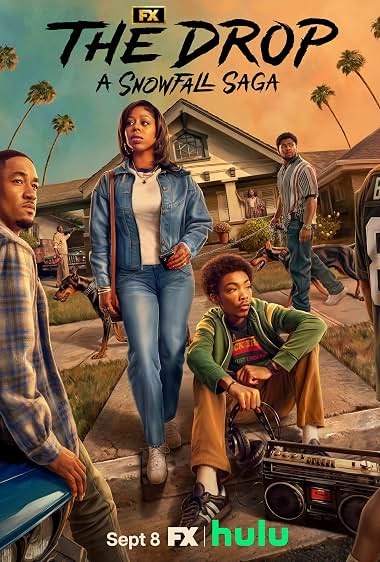
Over six seasons, Snowfall charted the explosion of crack in Singleton’s L.A. and revealed how even “good kids” like Franklin Saint (Damson Idris) could transform under systemic pressures bigger than himself, or the love his family and friends had for one another. Franklin’s best friend, Leon Simmons (Isaiah John), and Leon’s girlfriend, Wanda Bell (Gail Bean) redemptive arcs became fan favorites. Now, their survival anchors the spinoff, The Drop: A Snowfall Saga.
The Insert and Liner Notes
The Drop opens in 1990, four years after the original series. Wanda overcomes crack addiction, while Leon, racked with survivor’s guilt, runs a neighborhood legal clinic. Haunted by their pasts, they’re searching for purpose through redemption. Wanda’s cousin, Lamar Kinsey (Asante Blackk), emerges as a prodigy producer who hopes to break into California’s emerging gangsta rap scene. However, family tragedy and the city’s relentless cycles of violence cast a shadow over his dream. Kinsey family patriarch James ‘Big Daddy’ (Mykelti Williamson) and Gerty (Nicki Micheaux) fight to protect Lamar from the fate that claimed his mother. Desperate for help, they enlist Lamar’s older brother James (Peyton ‘Alex’ Smith), a reforming gang member, to keep him safe.
Bootlegs & B-Sides (I Know, I Know But I Couldn’t Help Myself)
That subheading is actually the title of my favorite West Coast compilation album by Ice Cube. Even today, nine-year-old me will defend the “You Know How We Do It” remix as a sonic masterpiece (said with Deontay Wilder’s seriousness). QD III (Quincy Jones III) cooked, like really cooked! During the Predator (1992) and Lethal Injection (1993) sessions, Cube recorded more than he could officially release.
Set in 1990 and 1991, The Drop intentionally features anachronistic tracks like DJ Pooh’s “Whoop! Whoop!” (1997) and Kendrick Lamar’s “m.A.A.d city” (2012). This choice is not a mistake; it’s a deliberate thematic decision. These songs connect the era portrayed on screen with the often misunderstood present West Coast culture. As a result, the music foreshadows the resilience and legacy of L.A. rap beyond strict 1991 timeline accuracy. Just like Bootlegs & B-Sides, The Drop stays aggressively, sonically “West Coast,” even as hip-hop’s East Coast boom-bap era was taking over at the time.
(Sidenote: Cube gets cooked, like really cooked on “Whoop! Whoop!” The history and lore behind the diss is all types of cool sh*t.)
LA’s Hip-Hop DNA: MCing, DJing, Breakdancing, Graffiti, and Knowledge (But Hold Up, FUBU?)
The Drop works hard to highlight how L.A. contributes to all five established elements of hip-hop culture. The mercurial Blood-affiliated Arthur “Artillery” Coleman (Buddy) stands out as the story’s official MC. His raw, anti-police lyrics echo the frustrations of real-life rap supergroup N.W.A., which Ice Cube co-founded.
For instance, real-life L.A. DJs like Greg Mack and the fearless crew at 1580 KDAY broke N.W.A.’s earliest street records. But they couldn’t risk losing their FCC broadcast license by playing “Fuck tha Police” on the radio. Instead, underground DJs bought Straight Outta Compton cassettes at swap meets and spun “Fuck tha Police” at backyard parties, roller rinks, and underground clubs. Fans made “dubs” of the song, recording it from cassette to cassette. It became an underground, viral phenomenon purely through this physical tape-trading subculture. On The Drop, it’s Wanda who masterminds this, having Artillery rhyme over Lamar’s beats.
Aaron “DJ Hed” Drake portrays the show’s “L.A. DJ,” DJ Block. In 1991, the primary corporate logo for the New Era Cap Company looked completely different from the minimalist “NE” flag logo on modern caps. While artistic anachronism works with The Drop’s music choices, it doesn’t land the same way with fashion. DJ Hed just looks like DJ Hed, now, but asking us to look at the screen and believe he’s a DJ in 1991.
In addition, characters like Darryl “DG” Grant (Brandon Mychal Smith)—a former street figure turned predatory label executive—should not be wearing FUBU in 1991, not in Los Angeles. Yet we see bloopers like this in more than one episode.
Despite impressive attention to detail, from the cars and jewelry to the seething violence between L.A.’s Blood and Crip factions, the show’s wardrobe department bumped the turntable mid-jam. With access to Lade Iluyomade’s massive Die Frsh vintage archive, there’s no excuse for this loud, music-stopping “record scratch.” Ultimately, this creative complacency insults real hip-hop heads’ intelligence (knowledge) and threatens the Snowfall universe’s consistency.
The FX Crime and Drama
One thing the original “OG” Snowfall series was good at was metatextuality. From its episode titles to its evolving title card. Showrunners (including late co-creator John Singleton and Dave Andron) used a simple text treatment which acted as a micro-storytelling device. Each episode arc gradually decayed or transformed the text to mirror Franklin Saint’s rise and fall, alongside the destruction of his community. As a longtime close friend, Malcolm Spellman intentionally designed The Drop: A Snowfall Saga to carry on Singleton’s vision and authentically portray Black life in Los Angeles.
Instead of an evolving title card, The Drop used anachronistic California hip-hop classics. And also, not only are each eight episode titles packed with symbolism, but so are the episodes themselves. From “Click Pop, Street Matrix, Family Matters, The Big Push, Homecoming, Exit Wounds, Blood In, Blood Out,” to the season finale, “Hercules.” Like after the mythological hero to symbolize the extraordinary, crushing burdens and Herculean efforts the characters face as they fight to control their futures.
They very much convey that hip-hop can be just as dangerous as crack in the streets of L.A. For instance, like Jenny Favarella (Isidora Goreshter) or DG’s lawyer Leonard Vance (Eric Balfour) exploiting Black creativity for profit from insulated positions within the system. Their cold ruthlessness perfectly mirrors Teddy McDonald’s parasitic, government-sanctioned operations in Snowfall.
Dara (Aleyse Shannon) is Artillery’s relative, fierce protector, rap manager, and street boss. She’s also the inherited leader of his Blood set. In the show’s messier dramatic aspect, she gets involved with Leon, who’s on a vulnerable straight-and-narrow road to redemption. There’s also Leon and Wanda’s ghost from Snowfall’s past, Deon (Quincy Chad). These characters compromise Leon’s refusal to let gang politics dictate his choices. And Wanda’s willingness to manipulate dangerous situations for gain—reflecting a substance abuser’s risk-taking impulses—complicates that.
Each character carries on John Singleton’s true vision of how systemic oppression victimizes Black communities. Protagonists are forced to make impossible choices with no instruction manual. Then, that society labels them “ruthless (you know how we do it, ba-dum tss!)”. But nobody is ever 100% innocent.
The Verdict
If you can get past the FUBU blunder, The Drop’s crime, drama, and characters are compelling. The series trades the 1980s drug blocks of Los Angeles for the equally cutthroat boardrooms of the music industry. With The Drop: A Snowfall Saga, the Snowfall universe continues Singleton’s accurate portrayal of structural exploitation, making it incredibly honest, high-stakes television. So much gets established in eight episodes that I hope it gets a second season to expand even further. But let’s not revisit FUBU until its final season.