
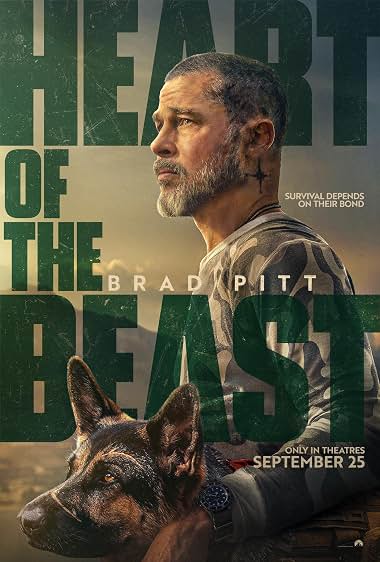
Heart of the Beast (2026) Is Exactly That: An Examination of the Emotional Relationship Between an Aging Special Forces Veteran and His Combat Dog.
An Ancient Bond and a Partnership Forged in Battle
Dogs became man’s best friend tens of thousands of years ago, forging a bond rooted in survival. Heart of the Beast is the latest guy-with-a-dog movie, but it succeeds in a genuinely cool way, honoring that primal connection.
Humans have relied on dogs in battle for millennia. In this film, Brad Pitt plays James Belmont, a decorated Army Special Forces veteran with PTSD. His best friend, Odin—a combat canine—carries his own trauma and visible scars, having saved James’s life. Uber II, a real-life New Zealand working-line German Shepherd, plays Odin. Now, it is James’s turn to return the favor.
The Power of a Real Performance
The last time I got misty-eyed at a guy-with-a-dog movie was Call of the Wild (2020). My son told me it was okay to cry, because the film earns it. But its character, Buck the dog, was computer-generated. In Heart of the Beast, Uber’s real performance deserves special recognition. He’s truly a talented animal.
Born in 2018 at Heisenberg Kennels in New Zealand, Uber originally trained as a police and search-and-rescue dog. He gained experience riding in helicopters, boats, and trucks. Hollywood animal coordinator Andrew Simpson discovered Uber. If you have ever wondered who trained Halle Berry’s dogs in John Wick 3, it was Simpson. He is also responsible for Uber appearing in this movie as if Odin and James Belmont have a lifelong bond.
Three of Uber’s pups—Ryler, Zika, and Hondo—handled his character Odin’s stunts. But it is Uber’s face that commands your empathy in close-ups and emotional scenes with Pitt. Odin’s expressive face, full of loyalty and pain, made me misty-eyed.
Brad Pitt Is in His “Having Fun With It” Era
At 62, Brad Pitt can, at will, bring grounded vulnerability and effortless movie-star presence to every role. As a lifelong fan—Cool World and Johnny Suede, I was into all types of cool sh*t, even at nine years old—I have always appreciated Pitt’s willingness to experiment. This is especially true in his recent, more intimate projects. Director David Ayer, who previously worked with Pitt on Fury (2014), guides him into some of his most nuanced work yet.
Heart of the Beast Is an Examination of Healing—Something Humanity Rarely Does for the 3,000 Animals Who Saved Thousands of Lives in Service Over the Past Twenty Years
After Iraq and Afghanistan, Odin has a prosthetic limb and titanium teeth. Hoping to heal, James takes Odin on a retirement trip into the Alaskan wilderness. Their encounter with a mysterious figure, Watkins, played by J.K. Simmons, shows, without words, just how deep their wounds run. Both man and dog are ready for violence. Pitt and Uber convey this pain with subtle, powerful acting.
A quiet campfire exchange between James and Watkins reveals the depth of James’s loyalty. He killed the men who left Odin with a prosthetic leg and titanium teeth. Before leaving, Watkins gives James a book with a note about survival, cruelty, and the healing power of love: “He had survived the worst the world could do to him. He had known the cruelty of man, yet he lives… and the love of man had taken root in his heart.” It is a fitting summation of the entire movie and marks the film’s last human-to-human interaction, showing James’s healing.
Pitt is not chasing blockbusters here; he is finding creative fulfillment in work that challenges him and us emotionally. His ability to evoke our suspension of disbelief is both effortless and masterful. That joy and confidence in this pursuit radiate through his performance, even in the agonizing, war-weary, PTSD-induced scenes.
Searching for Healing After War—Finding It in a Bond Beyond Words
James and Odin are trying to escape civilization’s wordly problems in hopes of healing. They are two battered veterans of human wars. James is trying to heal their mind and heart, but Odin, forever vigilant, does not know how. They fly a small Cessna into the crucible of Alaskan wilderness, hoping that solitude and sunlight beside a crystal lake might offer that. For a moment, it does. James enjoys a beer. Odin savors a fish he caught. The film lingers on these simple joys of fresh air and quiet companionship. It is a palpable sense of possibility.
But serenity in Heart of the Beast is fleeting. Odin’s watchful eyes remind us that rest is never guaranteed for war survivors. At its core, the film is about co-survival. Pitt’s restrained performance lets years of pain and competence speak through brief glances and quiet gestures. This is especially true in tender scenes, like James massaging Odin’s injured leg and not forgetting his old wounds.
Odin’s expressive acting, full of weariness and loyalty, rivals any human performer this year. The bond between Pitt and Uber feels authentic. It’s like they’re not master and pet, but two broken souls who know that only together can they survive. Heart of the Beast suggests that despite their hardened exteriors, it is that shared ancient primal connection—their capacity for love, absolute loyalty, and vulnerability—that serves as their sole mechanism for survival.
The Verdict
David Ayer collaborated with Academy Award-winning cinematographer Mauro Fiore to transform New Zealand’s breathtaking landscapes into a stand-in for Alaska. If you are wondering where a star and a half for an otherwise spectacular Brad Pitt movie went, it’s because of the CGI animal encounters. They break the spell of Fiore’s on-location photography. A flawless Cameron Alexander screenplay, Simpson’s work with the regal Uber II and his pups, then CGI bears and wolves?
Still, Heart of the Beast ends with clarity and understanding. It delivers a deeply engaging and emotionally resonant experience that masterfully invites us inside James’s and Odin’s inextricable bond. Their triumphs and travails feel lived-in, as do the supporting characters. This compensates for the CGI lulls. It stands out as a must for fans of the guy-with-a-dog genre, offering a world you will want to get lost in—Odin’s and James’s heart. Ultimately, it is a highly emotional adventure that successfully leaves a lasting impression well after the final credits roll.