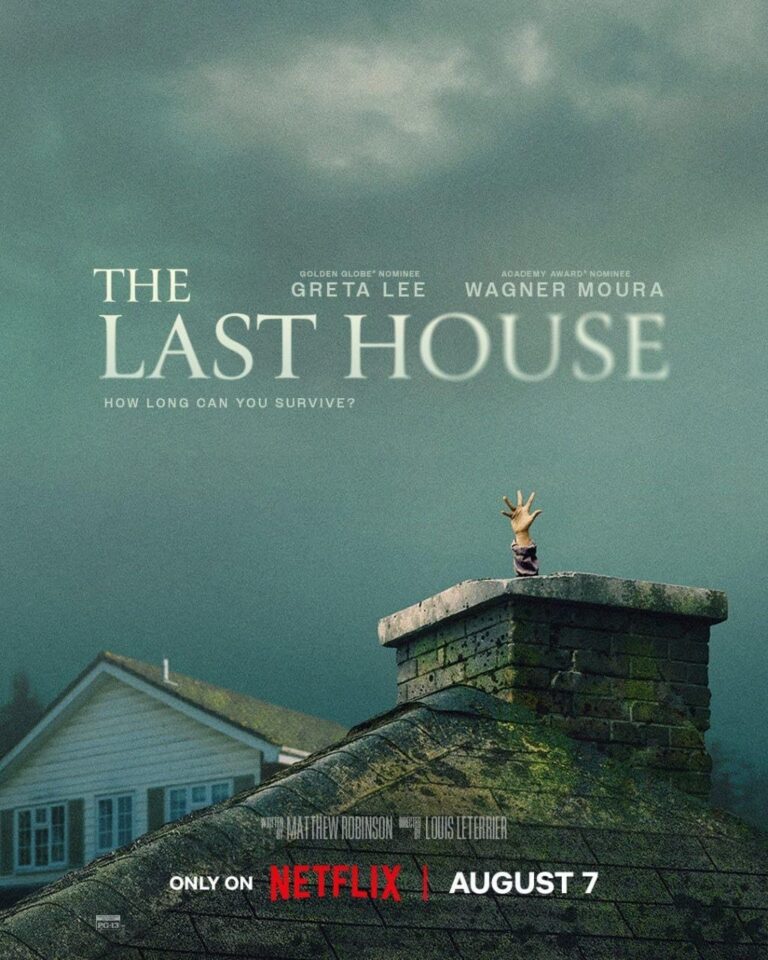
Streaming culture has a weird effect on the making of a movie and its reception in our modern times. Binge-watching, constant digital connection, and instant access to endless choices present unconventional possibilities for movie makers. Their Netflix Original could be an Oscar winner, like Frankenstein (2025) or Roma, or one of many forgotten about in a week. The Last House (2026) presents the latest opportunity for audiences to study this phenomenon.
Starring Greta Lee and Wagner Moura, a mom and dad mysteriously sealed inside their home with their dog and two kids, must work together to survive. As resources dwindle, they discover that not only is it an ominous force keeping them trapped—but also strange lifeforms. There’s a lot of potential to work with here, I thought to myself. It’s the kind of premise that makes movies worth watching.
Cosmic Horror Without a Clue: Tentacles, Tropes, and Tone-Deaf Takes
The Last House borrows tropes and genres liberally, often without paying homage to its creators. You get Cloverfield vibes, but also A Quiet Place and The Signs. Attentive viewers may even catch echoes of Will Smith’s I Am Legend. As a writer myself, the biggest offense to me was Lovecraft.
Many creatives avoid Lovecraft due to his well-documented racism and xenophobia, struggling to separate the art from the artist. Yet, to write effective Lovecraftian fiction, one must be fluent in his themes and conventions—much like the supernatural elements in his stories, you can’t meddle with them if you don’t know what you’re doing.
In classic Lovecraftian horror, evil arises from a blend of ignorance and greed, with monsters serving as metaphors for human reactions to cosmic indifference. In The Last House, however, the studio and its creative team seem more interested in a commercial cash grab than in thoughtfully engaging with these ideas. The film adopts Lovecraftian horror aesthetics but lacks the intellectual commitment and internal logic that define the genre.
The story initially hints at an ominous force manipulating the environment, from atmospheric disturbances to the unusual behavior of water droplets on windows. Yet, it abruptly introduces Cthulhu-esque monsters without any real understanding of cosmic horror’s foundations.
You can imagine how a studio brainstorming session went: “Make it look socially progressive, like a feature-length Dhar Mann movie.” “Make the dad cool—he cracks edgy jokes with his kids.” “Add unobjectionable themes and tick all the minority representation boxes; that’ll get us on Netflix’s Global Top 10 of the Week.” “And don’t forget to throw in Lovecraftian monsters, even if we don’t grasp the genre.”
Execution is Everything, to the Committed
When Cloverfield released in 2008, many viewers felt a monster terrorizing New York knocking over buildings was uncomfortable. It hadn’t even been a decade since Sept. 11. Both the War on Terror and the Iraq War were actively happening then. J.J. Abrams wanted to make a monster movie that showed a massive scale disaster purely from the chaotic, ground-level point of view of ordinary people. But it became a cult classic, spawning an anthology of two more films—one of which is a Netflix Original. All Lovecraftian influenced.
If you’re into all types of cool sh*t, you know that creators subvert Lovecraft’s racism and xenophobia to make something that moves humanity forward. Like Matt Ruff’s Lovecraft Country, The Ballad of Black Tom by Victor LaValle, or N.K. Jemisin’s The City We Became. All great books that I own and read. Ruff and LaValle’s subversions have hit streaming culture adaptations on HBO Max and Apple TV. Oh, Stephen King (his IT novel, all movies, and even IT: Welcome to Derry). The late, great John Carpenter’s “Apocalypse Trilogy,” and Big Trouble in Little China, too. All Lovecraftian influenced.
The point that I am making is that Lovecraft’s influence is present in almost all modern horror. To the initiated, we recognize his impact right away. S. T. Joshi knows Lovecraft’s work better any of us. Another is Mexican filmmaker Guillermo del Toro. I am a huge fan of his films. Del Toro has said that movies like Pan’s Labyrinth and Hellboy are inspired by Lovecraftian horror. Even the 2013 film Pacific Rim, which he co-wrote. Universal Studios cancelled his Lovecraft adaptation of At the Mountains of Madness. He applied that knowledge to Pacific Rim’s “the Breach” concept—located deep within the Mariana Trench in the Pacific Ocean—it’s an interdimensional portal leaking ancient, world-ending monstrosities.
Well, No One Expects a Netflix Movie To Win Oscars.
This kind of disposable filmmaking—an expectation ingrained in streaming culture—is why The Last House earns a two-and-a-half-star rating. Do you know how many Oscars Guillermo del Toro has? His overall filmography boasts an impressive total of eleven Oscars across all categories. Looking strictly at his collaborations with Netflix, his directed films have captured four Oscars, including a Best Animated Feature win for Guillermo del Toro’s Pinocchio and three craft awards for his gothic adaptation of Frankenstein. Incidentally, Lovecraft’s Herbert West–Reanimator is itself a parody of Mary Shelley’s Frankenstein.
“It’s not That Deep,” Subjectively Depends on Who’s Doing the Thinking.
There are people who pick up their remote or walk into theaters ready to give their immediate, unfiltered thoughts on a movie within minutes of walking out of the cinema. Streaming culture calls this “Out of Theater Reaction.” They can make anywhere from nothing to tens of thousands of dollars per video. Many have zero clue what any of this has to do with a review of The Last House. Welcome to the strange, shifting landscape of streaming culture. It changes how we value filmmaking, and our demand for the questions films pose or the answers they provide. The willingness to endure the painful, boring process of execution is what separates intellectually committed creators and informed consumers from the endless armies of “content creators” and passive scrollers, for whom movies are just stimuli in an infinite stream of nothingness.
Unlike Cloverfield, The Last House doesn’t grapple with questions about ordinary people facing city-destroying terror. Instead, it takes the horrors of the COVID-19 pandemic and repackages them as tone-deaf nostalgia. The film asks, “What if you couldn’t leave your home? What if you couldn’t pay the bills you were already struggling with?”—hence the rain motif. It raises the threat of empty shelves, looming power outages, and the loss of Wi-Fi or phone service? How long could you last?
While this scenario might serve as a fantasy for the privileged, it erases the real-life struggles of those actually displaced during the pandemic, rendering them invisible. The film repeats this triggering pattern with animal lovers as well, glossing over genuine issues in favor of an almost alien indifference. Ironically, this is the only time it gets cosmic horror right.
The Verdict
The Last House is written by Matthew Robinson and directed by Louis Leterrier, best known for his work in action films such as the first two Transporter movies, The Incredible Hulk (2008), Clash of the Titans, Now You See Me, and the tenth and eleventh installments of Fast & Furious: Fast X and the upcoming Fast Forever (2028). Leterrier also directed the Netflix series The Dark Crystal: Age of Resistance (2019) and Lupin (2021). The Fast & Furious films, in particular, are famous for their online discourse about defying logic—and for not taking themselves too seriously.
The Last House did, though. The result is an unfocused, superficial film that vacillates between eco-apologue and simplistic moralizing, ultimately insulting the audience’s intelligence. The only physical media that survived in the age of streaming culture were Annie and Air Force One DVDs? No books?
The superficial use of “In Between Days” by The Cure in a montage to indicate the passage of time forfeits the brilliance of the “Days Without Incident” narrative device from Leterrier’s The Incredible Hulk—a concept actually contributed by Edward Norton in his uncredited rewrite as an intellectually committed creator dedicated to great cinema. That device serves as a pacing tool, a structural frame, and a character anchor, externalizing Bruce Banner’s internal struggle and psychological state into a tangible metric. It creates narrative irony, since the audience knows the counter must inevitably reset to zero for the story to move forward. Leterrier borrows this device for The Last House as well, but by the end, the effect is underwhelming and unearned. You’re left thinking, “…I guess.”