
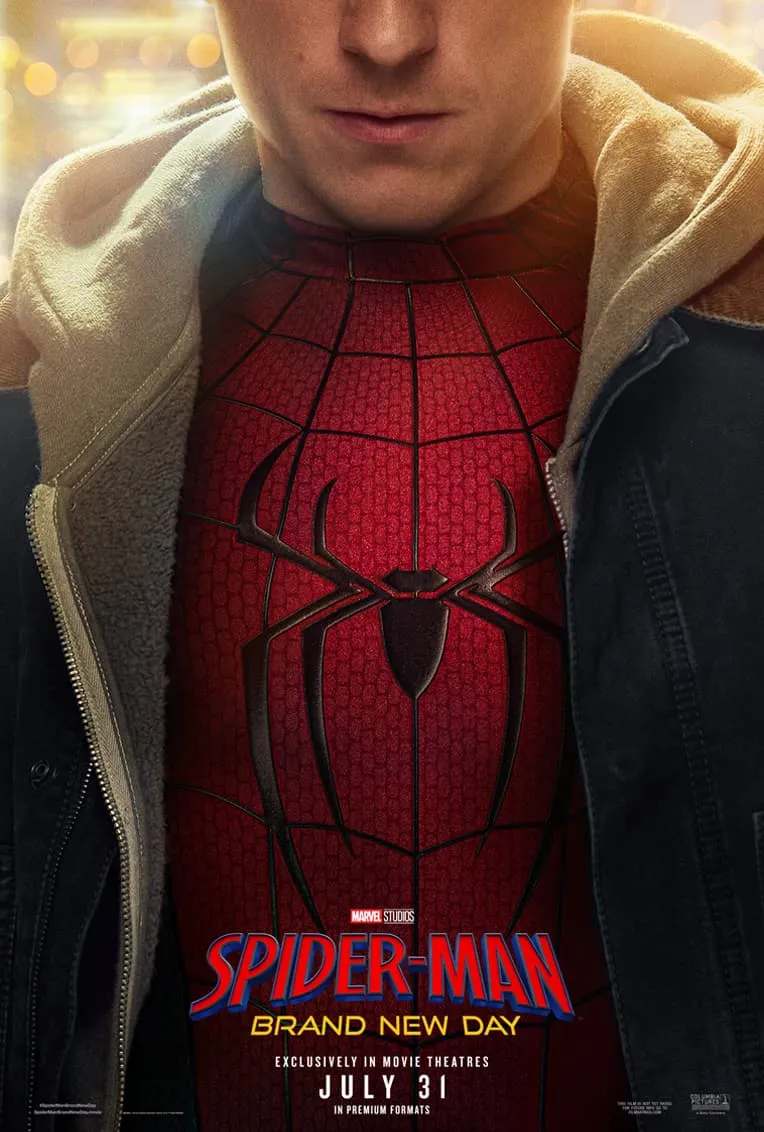
The Tragic Irony in the Title
In Spider-Man: Brand New Day (2026), director Destin Daniel Cretton and the film’s writers make one thing clear: isolation consumes. Being your friendly neighborhood Spider-Man means trusting people and believing in community. That’s always been Peter Parker’s greatest strength. But since 2021’s Spider-Man: No Way Home, Peter doesn’t quite know how. The Green Goblin (Willem Dafoe) killed Aunt May (Marisa Tomei). Peter vowed never to put his loved ones in danger again. Afterward, Doctor Strange cast a spell. It erased Peter from the memories of his best friend, Ned (Jacob Batalon), and his girlfriend, MJ (Zendaya).
The title serves as a double meaning. Creatively, it references the famous 2008 Marvel comic book arc Brand New Day. That story reset Peter’s status quo after a major reality-altering event. “Brand New Day” sounds bright, optimistic, and full of fresh opportunity. But it highlights that while Peter has been given a “fresh start,” free of the burdens of his past MCU identity, this brand new day is born from intense grief, total isolation, and the agonizing fact that the people he loves most have absolutely no idea who he is.
MCU’s Peter Parker and Spider-Man is Growing Up
It’s important to note that the “Home” trilogy, which concluded with No Way Home, was about establishing Peter Parker’s MCU origin. Stan Lee said from the start that he wanted Peter to be a regular guy. He was nobody’s sidekick—he was the hero. But behind the mask, he was just a regular high school kid. His biggest challenges were popularity, money, and girl problems.
Spider-Man: Brand New Day not only launches a second trilogy, but it also sets the stage for Marvel’s Phase 6 and beyond. After graduation, MJ and Ned return home from MIT, while Peter watches from afar, longing to be with them as a trio. Now, the stakes rise for all of them, especially Peter and Spider-Man. The sketches and doodles on graph paper, as De La Soul soundtracks the end credits have ended. And Peter’s art was already maturing into more than just a fun aesthetic. No Way Out’s drawings reflect a bittersweet chapter—a high school life and friendships Peter lost. But while they have moved on as adults, Peter still grapples with the memories and loss.
Sometimes it Makes Dollars, but no Sense
In the comics, Brand New Day was an editorial reset—the business side of storytelling. During this era, Spider-Man was single and fought street-level villains. In contrast, the MCU, under the unique Sony-Marvel licensing agreement, promised to integrate Spider-Man deeply into the existing Marvel universe. Including heavyweights like Tony Stark, and utilizing villains born from reverse-engineered tech from Stark or alien, Avenger’s Incident scraps from the Chitauri (such as Vulture and Mysterio), was a strategic move. This approach helped distinguish this version of Spider-Man from the Tobey Maguire and Andrew Garfield eras.
That’s why the Home trilogy often felt as if Spider-Man couldn’t carry these feature films alone. Although the creative team kept the same writers (Chris McKenna and Erik Sommers), Brand New Day director Destin Daniel Cretton took over and intentionally pivoted toward a Sam Raimi-esque approach. If you’re a millennial like me, those Maguire movies always seemed to flirt with the Man-Spider arc but never fully committed—Peter Parker’s horrifying, unstable mutation into a feral, multi-armed spider monster.
There’s Raimi’s inspirational claims which were that him and his screenwriter, David Koepp borrowed from James Cameron 1990s script. But any excuse for organic webbing will forever be offensive to me because it undermines Peter’s genius-level intellect. He is an expert in chemistry, physics, and engineering, and he famously invented his own high-tensile web-shooters and synthetic web fluid as a teenager using minimal resources. Regardless, Brand New Day takes those same Raimi-esque liberties; however, Cretton adds a few new, barely redeemable twists.
The concept originates from Marvel Comics (Marvel Fanfare #2) and also drives the “Neogenic Nightmare” storyline in Season 2 of Spider-Man: The Animated Series. After Disney completed its acquisition of 21st Century Fox, the MCU could finally use the word “mutant”—first officially spoken in 2022 in the Disney+ series Ms. Marvel to describe Kamala Khan. For Spider-Man: Brand New Day, Marvel kept Sadie Sink’s character under tight wraps throughout the promotional tour. Here’s a hint: she’s a mutant—an Omega-level telepath.
Just Being Honest…
I’m a fan of Destin Daniel Cretton, the director behind Shang-Chi and the Legend of the Ten Rings. He’s also at the helm of the TV series Wonder Man. Cretton used both projects to expand on his vision of fan-favorite Trevor Slattery (Sir Ben Kingsley). Slattery, first introduced in Iron Man 3, was the actor hired to be the face of the legendary terrorist known as the Mandarin.
In Wonder Man, there isn’t a traditional villain. Instead, the antagonistic Department of Damage Control (DODC) takes center stage. Its high-ranking agents act out of self-interest, and one pressures Trevor to leverage his friendship with Simon Williams. He’s has unstable, ionic powers triggered by stress. Similarly, in Brand New Day, the agency complicates not only Spider-Man’s belief in community but also the fate of a mysterious, unnamed character played by Sadie Sink. While Spider-Man believes he’s helping by cooperating with the DODC, this alliance forces Sink’s character—whose powers rival the most dangerous mutants—to defend herself. As a result, their actions put New York at risk.
From Shang-Chi to Wonder Man, Cretton’s greatest strength is weaving complex plots around sophisticated emotional intimacy. I even predicted Emmy nominations for Wonder Man, and Yahya Abdul-Mateen II received one for Outstanding Lead Actor in it. On the corporate side of Hollywood, Marvel’s formula works much like the Super Serum in Captain America. It does not change a character’s core, but it amplifies what is already there. For Wonder Man, a character built on nuance and vulnerability, Cretton’s decision to opt out of the formula worked beautifully.
However, Tom Holland’s Spider-Man fundamentally needs that formula. The Sony-Marvel licensing agreement made this version of Spider-Man dependent on it. Interconnected MCU cameos, tech-driven stakes, and relatable youth culture all play a part. Because Spider-Man is naturally a good, charming kid, the Marvel formula provides essential structure. By choosing to opt out and pushing Peter into a raw, isolated adult world, Cretton fundamentally “nerfed” MCU’s Spider-Man. Without the formula, the film forces Holland’s solo performance to carry the massive weight of a franchise transition alone.
Brand New Day, for Phase 6
If you’re into all types of cool sh*t, it’s easy to spot how street-level villains from the comics—like Mister Negative, Menace, and Freak—get swapped out. For example, the missing Neogenic Recombinator doesn’t turn Michael Mando’s Mac Gargan from Homecoming into the super-powered Scorpion. Instead, as teased in the post-credits, his tech-heavy transformation comes courtesy of Adrian Toomes (Vulture) and some reverse-engineered Chitauri scraps. And instead of Peter getting on-campus advice from Professor Curt Connors—who showed up in No Way Home—Professor Bruce Banner (Mark Ruffalo) is Brand New Day’s stand-in. Zero days without incident. Sink is already cast in the upcoming Avengers: Secret Wars, so this is her soft launch.
Think about it: Cretton’s and Co DODC’s aggressive, clandestine tracking and experimentation on mutants establishes the exact systemic fear and persecution that defines traditional X-Men. But then, her mysterious, unnamed character is so young in Brand New Day. Phoenix Force? I don’t know, it’s hard to see where Cretton is trying to go.
Oh, I forgot! This is a Spider-Man Movie Review… Must’ve Been Strange’s Spell
Ultimately, Spider-Man: Brand New Day aims to ground Marvel’s flagship character in his friendly neighborhood, street-level roots—this time, as an adult. Peter believes it is his moral duty to repress his grief, isolate himself from MJ and Ned to live entirely as a full-time Spider-Man. This movie functions as the psychological deconstruction of that choice.
This tonal shift gets a major boost from the introduction of Marvel’s TV superstar, the world-weary Frank Castle—the Punisher. Jon Bernthal brings a harsh, violent edge that stands in stark contrast to Spider-Man’s idealistic code, setting up a profound ideological clash that anchors the third act. Street-level threats also push Spider-Man to adapt, including the ancient assassin clan known as the Hand. The fight scenes feature choreography that truly raises the bar.
The Verdict
But the film doesn’t aim at Gen Xers or even ’90s Animated Series-indoctrinated millennials like me. It also skips casual viewers chasing corporate synergy or quick cameos for social media buzz. Instead, Brand New Day targets an audience on the edge of emotional maturity—those who grew up with Tom Holland’s Peter Parker and now face the adult burdens of loss, rent, and anonymity. The film captures today’s urban isolation. It speaks directly to a generation navigating a lonely, hyper-connected world. Even Spider-Man, at his best, swinging through New York City’s concrete canyons, can’t survive the human experience alone.
If you can’t trust people or believe in community at the street level, how can you defend it against Avenger-level threats cashing in on future Marvel blockbusters? How can you defend Earth itself? Brand New Day’s chaotic plot delivers breathtaking acrobatics, fierce fight choreography, psychic assaults, young adult heartbreak, machine guns, and even a bit of Hulk smashing. Zendaya stands out with remarkable subtlety. Her interactions with Peter hold faint, phantom familiarity—a fleeting glance, a paused sentence—capturing the tragic essence of a love stripped of its history. In the end, this is how Spider-Man: Brand New Day sets itself apart, making it more than just a placeholder for Marvel’s next Phase.