
A Legendary Writer and Director’s Recipe for Creating Modern Cinematic Classics
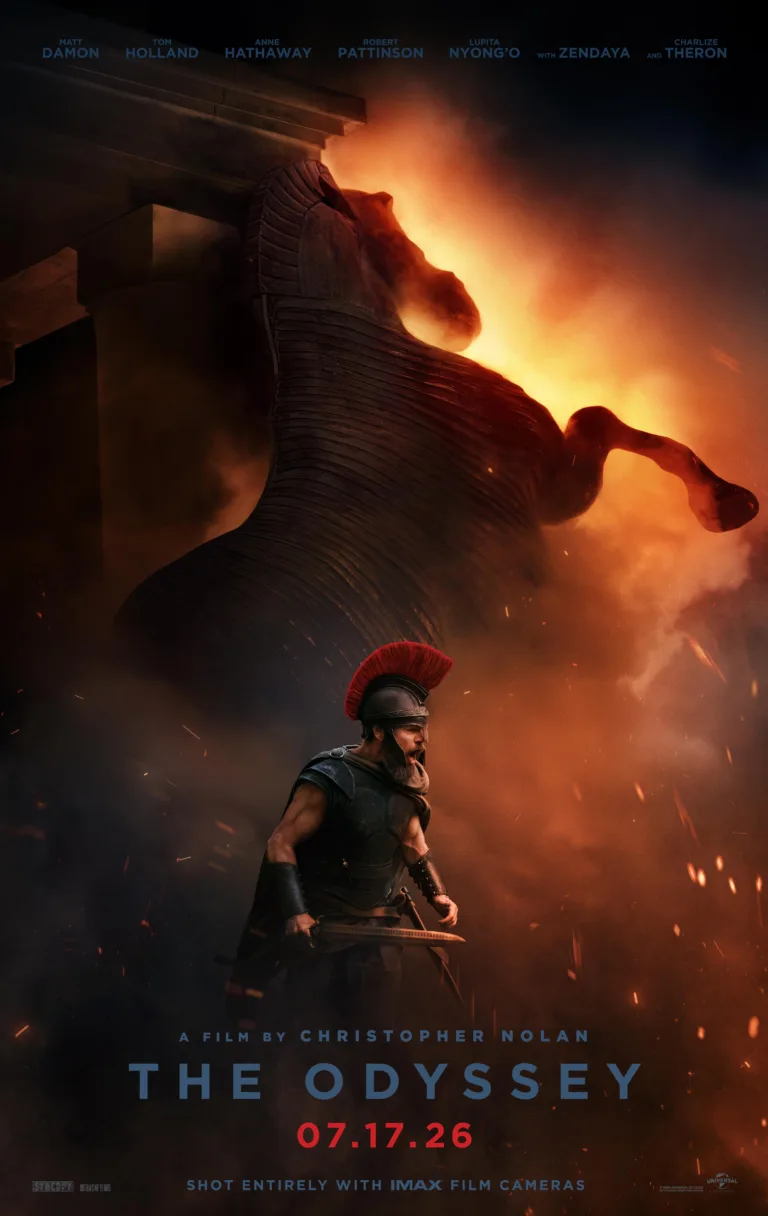
The detailed story of the fabled Trojan Horse is not actually found in Homer’s The Odyssey; it appears at length in Book II of Virgil’s Aeneid. In the 2026 film The Odyssey, two-time Academy Award-winning director Christopher Nolan boldly blends these myths. As director, Nolan works his magic with fractured timelines and psychological depth, exploring complex sides of human identity. The result is a film that both honors and reinvents the ancient epic for a new generation.
The Living Mirror of The Odyssey
Though born from an oral tradition nearly 3,000 years ago, The Odyssey hasn’t aged. Centuries of evolving translations have continually adapted its ancient text into a living mirror for each new generation. In 2017, Emily Wilson became the first woman to translate The Odyssey into English. Her version, with its lean clarity and momentum, has replaced older translations on many high school and college syllabuses. Last year, Nolan told Empire magazine that his movie owes its inception to the very first line in Wilson’s translation: “Tell me about a complicated man.”
A Complicated Journey Home
The Odyssey follows Odysseus, king of Ithaca, on his perilous journey to return home after the Trojan War. While he struggles to find his way back, his wife Penelope (Anne Hathaway) and adult son Telemachus (Tom Holland) fight to protect their home from savage suitors. The film explores their loyalty and the many hardships they endure as they wait for Odysseus. Ultimately, he must find his way back not only to Ithaca, but back from the complicated man he realizes he has become.
Is a Nearly Three-Hour Runtime Justified?
Did Nolan really need 173 minutes—that’s 2 hours and 53 minutes—to tell this story? Oppenheimer has a runtime of exactly 180 minutes (3 hours), making it Christopher Nolan’s longest film, surpassing his previous record-holder, Interstellar, at 169 minutes. The Odyssey doesn’t feel laborious, but it does approach that threshold. My wife compared the experience to sitting through Gladiator on one of our date nights when we were younger. However, she said she enjoyed The Odyssey even more—and not just because she’s a huge fan of Matt Damon and Anne Hathaway. I explained that Nolan has a way of rewarding viewers for long runtimes. His emotionally resonant endings rely on our deep investment as viewers. Spending so much time in his worlds, we become immersed in the high stakes of his stories. This makes the journey feel worthwhile.
Parallel Timelines and IMAX Brilliance
In its runtime, The Odyssey weaves together parallel timelines—the Trojan War, Odysseus’s stranded decade at sea, and his family’s peril back in Ithaca. As Odysseus struggles with guilt over the sacking of Troy, he recounts his legendary encounters with mythical adversaries: the Cyclops, Scylla, Charybdis, and the Sirens. If this is to be an objective review, this film’s runtime would be my only legitimate critique. But then the realization of what is captured by cinematographer Hoyte van Hoytema, using reliable, large-format IMAX film technology, sets in.
The Tactile Power of Shooting on Film
As a millennial—and as my wife as a casual moviegoer realized—there’s something that leaps off the screen when movies are shot the old-fashioned way, on film with in-camera practical effects. If you’ve read Emily Wilson’s translation of The Odyssey, it hits you that Nolan is applying these effects to an exploration of Wilson’s very short, first passage:
“Tell me about a complicated man. Muse, tell me how he wandered and was lost when he had wrecked the holy town of Troy and where he went, and who he met, the pain he suffered in the storms at sea, and how he worked to save his life and bring his men back home. He failed to keep them safe, poor fools, they ate the Sun God’s cattle, and the god kept them from home. Now goddess, child of Zeus, tell the old story for our modern times. Find the beginning.”
Visceral Naturalism Over Digital Polish
Nolan eschews the digital, weightless polish—an expected prerequisite that, for years, has come to define modern blockbusters. Instead, he embraces a visceral naturalism, where every wave feels heavy enough to drown you. The claustrophobia is palpable when Odysseus and his men are trapped inside a seaside cave with Poseidon’s giant one-eyed son, the cyclops Polyphemus, or under siege from Nolan’s reimagined Laestrygonians. Every Trojan wall engulfed in flames collapses with real, crushing force, making this epic feel both mythic and intensely actual—Nolan style.
Unforgettable Performances and Myth Reimagined
Bill Irwin voices the Cyclops Polyphemus with haunting vulnerability, making the creature both terrifying and memorable. The design is striking, and his sudden violence is deeply unsettling. Charlize Theron’s Calypso inhabits the role with haunting grace, embodying the aching solitude of her island prison. Her performance transcends the trope of captor, rendering Calypso as a tragic soul bound not by power, but by the lonely chains of fate. The lotus flowers she gently compels Odysseus to eat become a symbol of this sorrow—each petal a bittersweet plea to forget, even as both remain prisoners of longing and memory.
Samantha Morton’s Circe also stands out, discarding the typical enchantress trope for a more physical, hands-on magic. She transforms Odysseus’s men into beasts in a way that feels raw and disturbing, revealing their true natures. Ludwig Göransson’s score blends ancient sounds with mechanical tension, adding to the film’s psychological edge. Fast, sometimes dizzying editing in early sea scenes mirrors the crew’s panic as they face the unknown.
The Heart of Ithaca
While Odysseus battles monsters, the film’s heart stays in Ithaca. Ruth De Jong’s production design casts the palace as a besieged stronghold, not a prize. Anne Hathaway shines as Penelope, portraying her as sharp, resilient, and exhausted by years of survival. Tom Holland’s Telemachus is vulnerable and determined, while Robert Pattinson’s Antinous is chillingly ruthless. There are lines in the film that highlight Nolan’s comprehension of these myths and the fables’ translations. Like John Leguizamo, who adds depth as a blind elder Ithacan, Eumaeus, personifying the loyalty of the lower classes against the greed of the elites.
Odysseus’s Guilt and the Shadow of Troy
Though The Odyssey is an adventure story, Nolan’s version also shows Odysseus grappling with guilt about the future of his world. We find that he’s been struggling to return home because of what he became and witnessed during the Fall of Troy. He blames himself for the destruction caused by his Trojan Horse plan.
An Ensemble That Elevates Every Moment
Jon Bernthal plays Menelaus, the King of Sparta and the younger brother of Agamemnon, in Christopher Nolan’s adaptation of The Odyssey. Menelaus is the Greek ruler whose wife, Helen of Troy, is abducted, sparking the Trojan War.
There’s a powerful subplot featuring Elliot Page as a Greek soldier, Sinon, whose grim fate haunts Odysseus. It is in these poignant moments you realize Nolan doesn’t write these characters and stories as a cold intellectual. His characters actually have profound emotional depth, shaped by the challenges they face as human beings.
Lupita Nyong’o, playing an elegantly uncompromising Helen of Troy and her twin Clytemnestra, stands out in her brief scenes. The controversy over casting a Black woman as Helen was an afterthought. I truly forgot it was once a thing in online debate surrounding the film. We’re talking about a woman conceived by a shapeshifting god, hatched from a swan egg. Canonical skin color, really? Nolan has a way of acknowledging and winning such petty debates without cheapening his work by not answering it directly. He shows you progress without arguing it. The same goes for Himesh Patel as Odysseus’s second-in-command. No character nor screen time is wasted.
A Hero Without Easy Answers
What Nolan’s writing does best is refuse to give any of his characters—Odysseus included—easy answers. Matt Damon brings the character to life without the usual noble theatrics of a mythic king. Instead, Damon plays Odysseus with stoic, worn-down exhaustion. His famed cunning and wile come not from heroic genius, but from desperate, survivalist pragmatism. He is a battle-worn veteran who has done unforgivable things just to keep himself and his men alive.
Catharsis Denied: The True Cost of Surviving
The climactic return to Ithaca is violent and offers no easy catharsis; the cycle of violence from Troy continues at home. The final reunion between Odysseus and Penelope is tense and haunting, as both recognize the cost of survival. Zendaya appears throughout the movie as the goddess Athena, guiding Odysseus through his challenges. By the film’s climax, we learn that the Athena he sees is actually the face of a young woman he saw killed during the sack of Troy. Her image haunts him, symbolizing his deeply human regret and pain over what he’d become.
Athena or Cassandra? And the Weight of Mourning
This powerful reveal transforms the meaning of Odysseus’s journey and every choice he has made. In myth, Cassandra is the war’s most tragic victim. By blending her fate into the character of “Athena,” the film gives Zendaya’s goddess a profound sense of mourning for the collapse of empires. But it is Cassandra who is brutally raped by Ajax the Lesser (also called Locrian Ajax) during the sack of Troy, attacked inside the Temple of Athena while she clings to the goddess’s statue for protection.
In Homer’s The Odyssey, this assault is not depicted directly, but is later referenced when Agamemnon’s ghost recounts his and Cassandra’s tragic deaths at the hands of Clytemnestra and Aegisthus. The violation’s sacrilegious nature is central in Greek mythology, igniting divine anger and bringing the gods’ wrath down on the Greek victors. Somehow, Nolan presents his new interpretation right before The Odyssey’s climax without explicitly detailing this mashup. But by mixing Athena’s grief with Cassandra’s suffering, Nolan deepens the film’s meditation on loss, justice, and the scars left by war. True to the original epic, disguised as a beggar, Odysseus explaining these horrors to Penelope sets up a redemptive third act.
Odysseus’s Monologue About The Breaking of Zeus’s Law
“Ten years of rage pour into that city in one night… We violated all that’s ever sacred between people… What if he knew, that very night, as he walked through fires, anarchy, and pain—and in a daze of sweaty celebrations that follow—what if he knew exactly what he’d done? One man’s idea. One man’s trick to break Zeus’s law forever. We lived in a world of palaces and trade, language, blind to its beauty, until we broke it. Yes, my queen. The breaking of Zeus’s law, spreading like plague. Our age of bronze is collapsing, and maybe he couldn’t bear to see the ruins of what he’d done. Anywhere. Least of all, his home.”
Nolan’s “complicated man,” Odysseus.
A Modern Classic Is Born
The final act focuses on Odysseus and his son Telemachus (Tom Holland). It highlights how an older generation trapped in endless wars has failed, leaving their children to navigate the future. After one last battle to right the wrongs that have even corroded Ithaca, Odysseus feels responsible for the retaliation ahead. “Songs will be all they have to remember those of us who can write,” Odysseus tells Penelope. “Civilization will rise again,” she reassures him. “our mistakes will once again be forgotten.” The whole setup is one of my favorite sequences in the film. It’s a meta-commentary on Nolan’s own work as a writer. He’s explaining why he chose to adapt a 2,800-year-old poem into a modern cinematic epic—treating his The Odyssey as a contemporary equivalent of ancient oral traditions.
To drive this message home, the film segues directly from Odysseus’s final lines into a modern hip-hop and neo-classical end-credits song called “When I’m Home.” It’s co-written by Nolan himself alongside Travis Scott, Ludwig Göransson, and James Blake. By closing a Bronze Age epic with urgent, contemporary resonance, Nolan reveals that the iconic tale of the Trojan Horse lives more in our collective imagination than in the pages of Homer’s Odyssey. Nolan’s “translation” of The Odyssey becomes more than an adaptation—it’s a powerful reflection on the cycles of history and the darkness that can follow us home. So is The Odyssey a modern cinematic classic? I think it’s close, but with Nolan movies, only time and a few rewatches will tell. Homer has had almost the last 3,000 years.