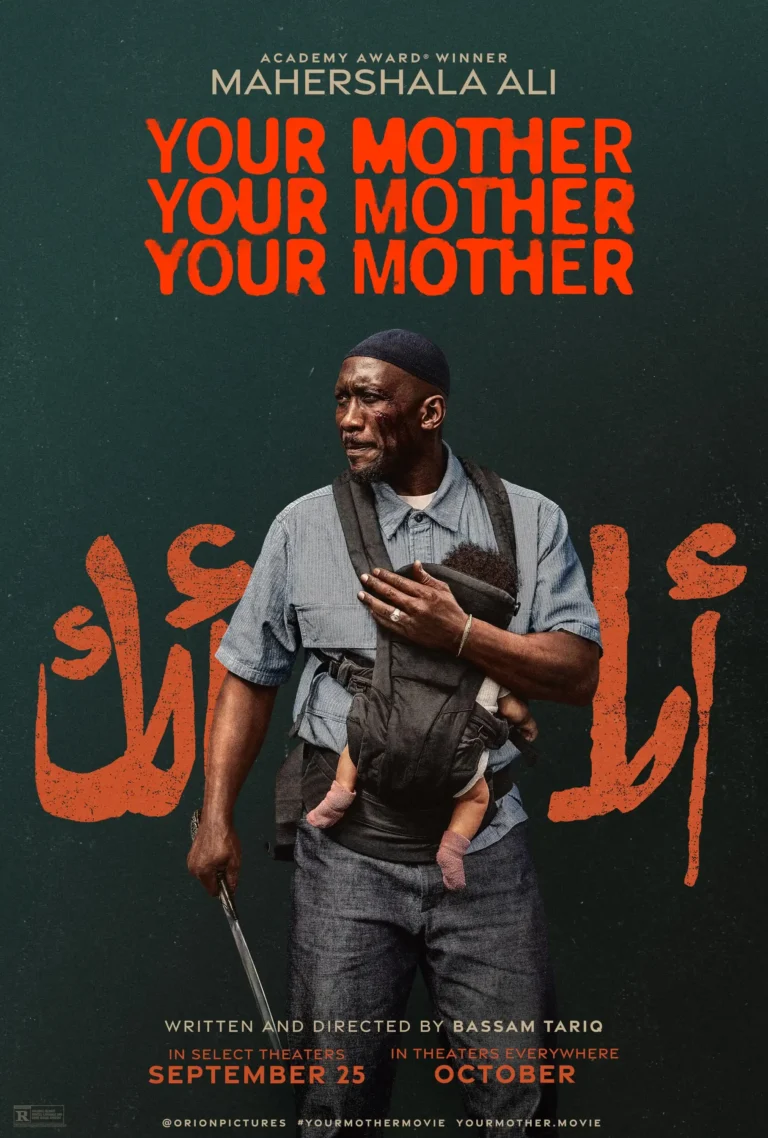
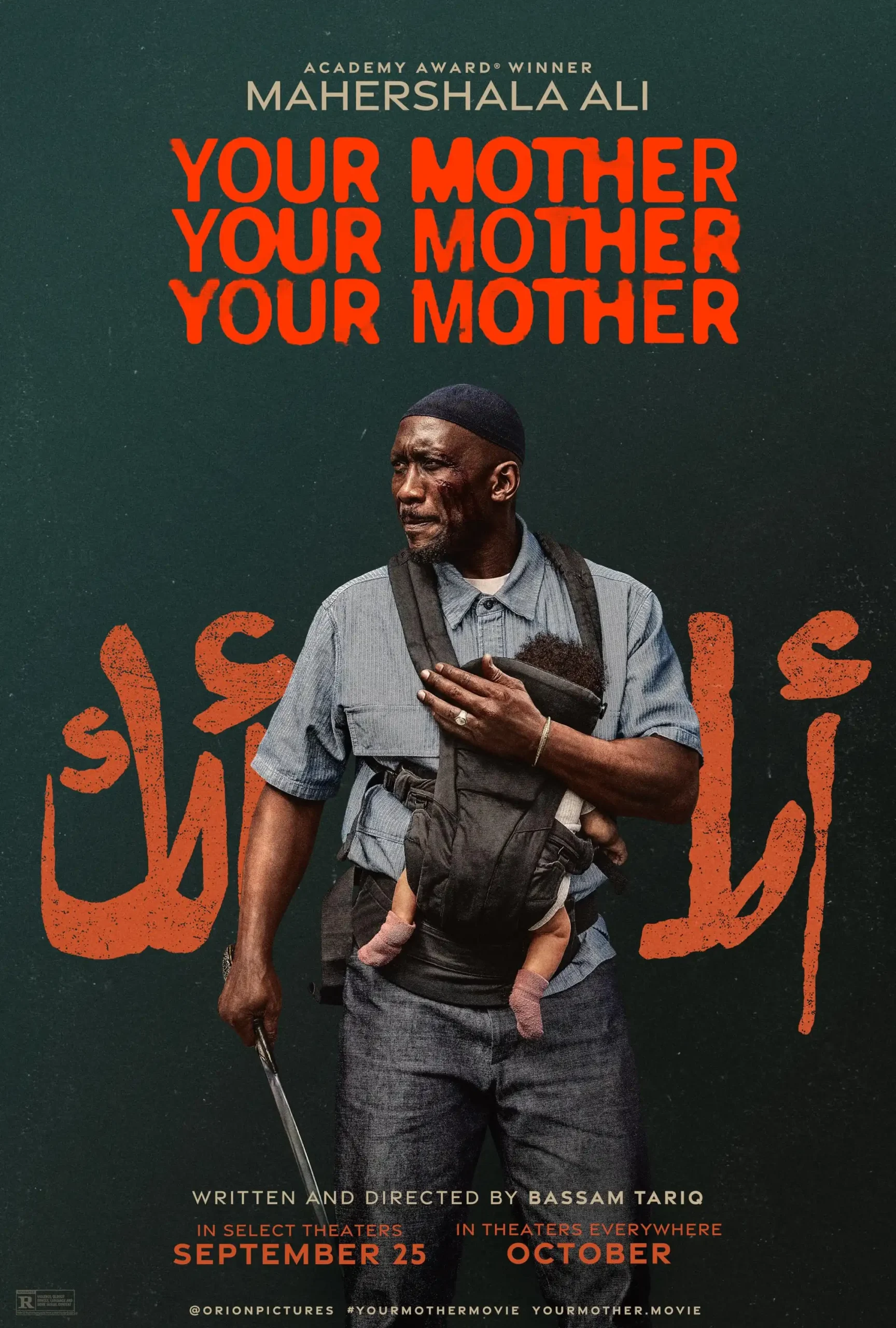
Oscar-Winning Mahershala Ali Stars as a Sword-Wielding Muslim Hitman Who Becomes a One-Person Army at the Center of a Spiritual War in Houston While Trying to Secure Breast Milk for His Infant Daughter. Yes, Really. You Just Have to Believe.
Wesley Snipes was 36 when the original Blade (1998) hit theaters. Mahershala Ali was 45 when Marvel announced his casting as Blade’s reboot at San Diego Comic-Con in July 2019. The project spent nearly seven years in development. It cycled through six writers and faced countless delays. Eventually, Marvel shelved it. When Ali officially moved on, he reunited with the Blade reboot’s director Bassam Tariq. Together, they shot Your Mother Your Mother Your Mother. And yes, despite the Marvel aside, this is, in fact, a review of that film.
Tariq began writing the script during COVID-19. He hadn’t even met Ali yet. But from the start, Your Mother Your Mother Your Mother was about loss and grief. Tariq wanted to focus on the quiet dignity and resilience he’d observed among some in the Muslim community. Ali, a Muslim himself, embodied that authenticity and grace Tariq was looking for, and talent. Not to mention extensive body-transforming physical training—martial arts and sword training, too—indirectly paid for by Marvel.
Their scrapped Blade project provided everything they both needed—physically, mentally, and in many ways, even spiritually. Or was it a higher power all along, and all they had to do was believe? From Tariq’s writing and directing to Ali’s phenomenal talent as a performer, this transcendental force manifested in this movie, Your Mother Your Mother Your Mother.
What Does the Title Mean?
Like Ali’s character Latif in Your Mother Your Mother Your Mother, my dad is a Muslim. His proudest moments were taking me to the mosque. The title comes from what Islam calls “Hadith.” Its purpose is to document the words, actions, and approvals of Prophet Muhammad, serving as a practical guide and the second major source of Islamic law and knowledge after the Qur’ān. In this one, the Prophet states that a mother deserves love and honor three times before a father is ever mentioned.
In the film, Latif is a Houston hitman who’s driven solely by his dedication to Islam and love for his children. When his wife dies, he’s left to care for their teenage daughter Fatiha (Adia), a young son Qadir (Jahleel Kamara), and their infant daughter Aziza (also called Zizi), who cannot tolerate formula. She needs her mother’s frozen breast milk, but it’s running out. Latif’s life suddenly spirals out of control trying to fill his wife’s shoes by finding more.
Latif tries to get breast milk from women at his local mosque, which is led by Abdul Malik (Giancarlo Esposito). However, the mosque becomes the place where Latif’s complicated life as a reluctant assassin with a questionable moral code truly tests his faith. Through a misguided breastfeeding sex worker, Fugazi, played by Tiffany Boone, a desperate Latif finds himself in the middle of an explosive spiritual clash in Houston between some Muslims with loose morals and Christian extremists.
Your Mother Your Mother Your Mother Asks: How Does the Battle Between Hypocrisy and Belief Play Out in the Mind of Someone Striving to Be Truly Devout?
I’ve seen this movie four times. The last time was an early screening with a Q&A afterward featuring Bassam Tariq and Mahershala Ali themselves. I asked a question about how, in the 9th century, Arabs introduced the idea of using Sub-Saharan Black Muslims as the ideal “foreign” mercenaries. I was referring to Ahmad ibn Tulun, and later, Abid al-Bukhari’s “Black Guard.” Their thinking was that these soldiers would be cold, unfeeling instruments of violence—socially and culturally isolated from Arab languages and lands, families, and affairs because of their skin color.
In the film, British-Syrian actor Laith Nakli effortlessly portrays Mike Mahmoudi. True to real-life history, Mike—a non-Black Muslim boss—uses Latif as his primary asset, reflecting the historically accurate dynamic between Arab leaders and Black Muslim mercenaries. There’s a scene where he wastes breast milk, not knowing or caring what it is, delusionally feeling betrayed that Latif didn’t want to kill for him anymore. His soldier, who does anything he tells him, says it’s breast milk; he knows because his own wife is nursing. Mike continues to waste life-saving breast milk, ironically yelling that he was like “brother” to Latif. Like a brother that helps secure breast milk, to avoid everything that’s unfolding?
Mike’s criminal syndicate in Houston needed Latif to protect his nephew Hatty (Abubakr Ali), whose on-screen conflicted view of Islam is magnetically honest. Hatty is Latif’s former student and now Houston’s “king of Habibi porn.” This makes him a target of Pastor Hwan Yoon (John Cho), a radical, gun-worshipping Christian nationalist leading a violent anti-porn crusade. Yoon even converts one of Hatty’s strip clubs into a church. When a desperate Latif forces Hatty to take him there for Fugazi’s breast milk, these crises of faith collide, exploding into spectacular violence—and the chaos doesn’t stop.
Through Fatiha, Tariq Asks: Is Doubt an Inherent, Necessary Part of Faith, Rather Than the Absence of It?
The club-turned-church becomes the film’s igniting battleground—literally and symbolically. Fugazi, once a sex worker in Hatty’s business, is “liberated” by Pastor Yoon. She converts to Christianity and joins his congregation with zealous devotion. In a desperate attempt to protect Zizi, Latif desecrates the newly sanctified church during a violent brawl. This act sparks a cycle of brutal retaliation. Pastor Yoon responds swiftly, directing his rage at Latif’s local mosque and pushing the community into deeper turmoil.
This clash of faiths and moral codes gives Your Mother Your Mother Your Mother its sharpest edge. The film never offers easy answers. Instead, it exposes the contradictions and hypocrisies that surface when ideology turns extreme. Every sanctuary—mosque, church, or even the fragile safety of family—becomes vulnerable. Talib (Tramell Tillman), Latif’s secular younger brother, and his wife, Tara (Alyssa Gihee Kim), flesh out these complexities.
Yet, amid the chaos and moral ambiguity, the film quietly shifts focus to Latif’s daughter, Fatiha. Her private struggle with belief and belonging suggests that the truest test of faith is not in grand gestures or violent crusades. It lives in the personal crises that shape our daily lives. In many ways, Fatiha’s doubt and questioning make her the film’s most devout character of them all.
The Verdict
Your Mother Your Mother Your Mother is a monumental work of modern Muslim diasporic cinema. Born in Karachi, Pakistan, Tariq grew up in the Astoria neighborhood of New York City before moving to the Houston, Texas area (including southwest Houston and Sugar Land). Filmed almost entirely in Atlanta, the crew did shoot second-unit footage in iconic Houston neighborhoods. This external footage seamlessly blends with Atlanta scenes, giving the movie an authentic Texas atmosphere and creates a microcosm of a spiritual war.
The Oscar-nominated band Son Lux scored it. Serving as the Director of Photography, Katelin Arizmendi captured the kinetic fight scenes and overall film with a stylized splendor that rivals John Wick. Tariq and Ali prove that blockbuster spectacle and arthouse intimacy can co-exist; you just have to believe.