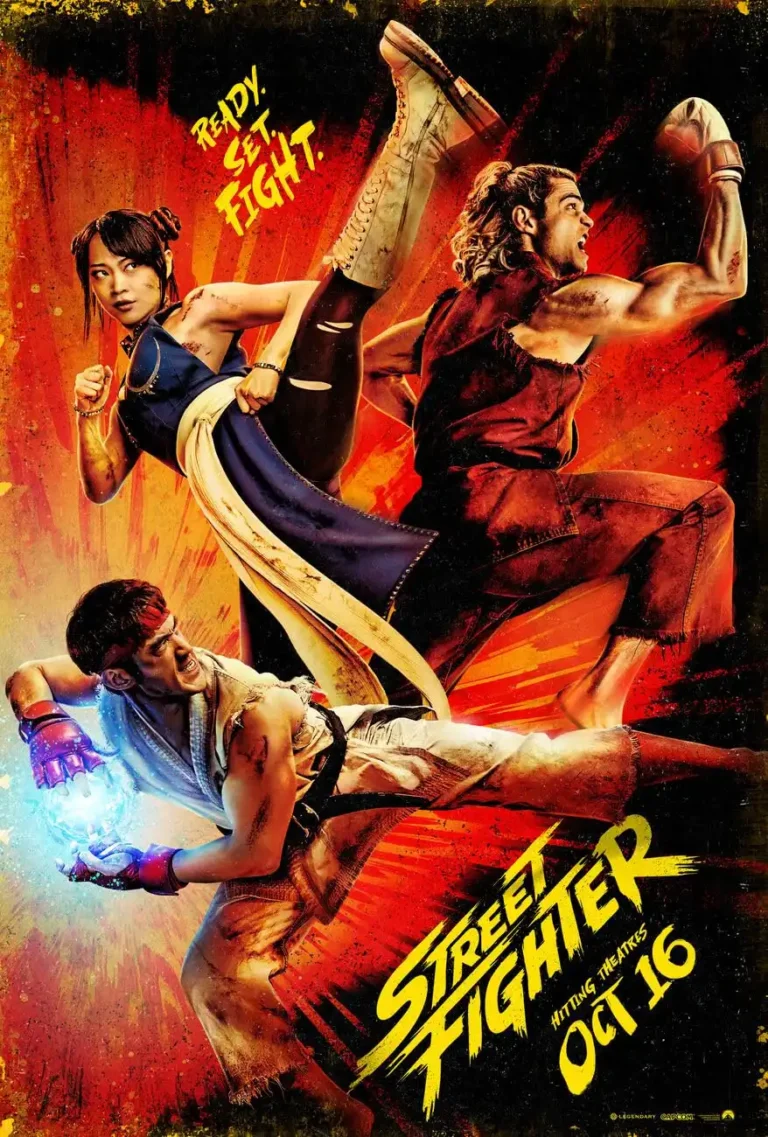
All the Millennial Critics With Something Negative to Say, Shut Up! Go Home and Be a Family Man. Our Childhood Selves Thoroughly Enjoyed This.
I remember it like it was yesterday. I walked into the corner store and heard the special effects blaring from the arcade cabinet: Street Fighter. Here, take my money! As Ryu (Andrew Koji), you fight Retsu and Geki, then fly to America and fight Joe. Mike, the towering Black guy in the red T-shirt, stands behind Mount Rushmore as the most epic video game music ever plays. That song lives rent-free in my head to this very day. Eventually, you end up in Thailand, fighting Adon, and then Sagat—who, at this point, is free of the iconic scar along his torso.
If you win, he tells you that you’ve outlasted the best. You are now the strongest street fighter in the world! It took me $10.00 and two $1.00 paper food stamps—$0.95 from each after buying a $0.05 piece of Bazooka Joe gum. That was 1988. Nearly $15 billion and 40 years later, the movie Street Fighter (2026) opens with this iconic battle. Animated and retconned to the max, but who cares?
With a Nostalgia Fest, There’s Stuff You Can Get Away With—and Things You Absolutely Cannot.
It was cool that director Kitao Sakurai chose to animate this backstory, in the same way that makes X-Men ’97 cool. This approach inoculates the audience with the essentials of Ryu and Ken (Noah Centineo), smoothly addressing decades of game lore and framing the characters’ motivations upfront before shifting gears into live-action chaos and absurdity. This structural choice ensures that when the live-action, over-the-top ‘1990s arcade aesthetic starts, the core emotional stakes are already fully understood.
Because I’m into all types of cool sh*t, there’s so much lore I could talk about from the franchise’s humble beginnings. Mike was supposed to be the final boss—Mike Bison, a nod to Mike Tyson. That’s why M. Bison’s name is M. Bison, and at some point, he even evolved to look like Vega. Out of this, Balrog (Curtis “50 Cent” Jackson) emerged.
Sagat doesn’t have his iconic scar in the 1987 video game. That’s because it wasn’t added until 1991 in Street Fighter II. Even then, the Dark Hado arc didn’t arrive until 1994 with Super Street Fighter II Turbo—Akuma, the ultimate embodiment of its corruptive power. The storyline formally manifested as a playable character arc with the debut of Evil Ryu in 1996’s Street Fighter Alpha 2, when Ryu is fully consumed by the Dark Hado that left the scar on Sagat’s torso.
Still, it was all about M. Bison’s “Psycho Power,” like in the 1996 Street Fighter II: The Animated Movie. Bison tracks down and tries to control world-class martial artists like Ryu, while Chun-Li (Callina Liang) teams up with an American soldier to bring down Shadowlaw. Basically, the franchise was working out these arcs and concepts as it went. Street Fighter (2026) seamlessly weaves all these decades of lore and arcs together within the film’s first 30 minutes.
Now, the Things You Cannot Do With a Nostalgia-Fest Like This.
“And I say, hey-ey-ey / Hey-ey-ey / I said, ‘Hey, a-what’s going on?’” 4 Non Blondes, released in 1992 on their album Bigger, Better, Faster, More! It’s essential to the movie’s plot, set in 1993—okay. But “This Is How We Do It” by Montell Jordan? That was 1995. “Ambitionz az a Ridah” off All Eyez on Me by Tupac, 1996? “Be My Lover” by La Bouche, 1995.
I’m not Rain Man, just a former DJ during college and film school, and also a hip-hop journalist. These are flagrant offenses. While I thoroughly enjoyed Street Fighter and was impressed by the seamless weaving of the lore and arcs, there’s no excuse for the music placement. By a DJ, in an entertaining fight sequence in a nightclub—it cost the movie one and a half stars with me. “Who Let the Dogs Out” by Baha Men—the year 2000—one star, seriously.
Wanna hear all types of cool sh*t? In the 1992 film Juice, Tupac as Bishop plays the Street Fighter arcade game. Enter the Wu-Tang (36 Chambers) came out in 1993. “Slam” by Onyx, “Insane in the Brain” by Cypress Hill, “Party and Bullshit” by The Notorious B.I.G.—all early 1990s classics. You could’ve swapped out Baha Men for “Whoomp! (There It Is)” by Tag Team—1993. Nostalgia is a very powerful thing; respect it like Hado, and don’t succumb to its dark side just to sell a movie.
It’s a 1990s Trip to the Arcade in Cinematic Form for Middle-Aged Millennials.
Andrew Schulz as Dan Hibiki, Cody Rhodes as Guile, Eric André as Don Sauvage, and David Dastmalchian as M. Bison provide some genuine comedy I’d like to see more of in the hinted sequel. Oh, what was the movie about? Ryu and Ken reunite when Chun-Li recruits them for the second World Warrior Tournament ever hosted by Bison. She wants to avenge her father by taking down his killer, Bison—the same guy who killed Guile’s partner, Charlie, and wants to harness Ryu’s Dark Hado to enhance his Psycho Power. So the tournament isn’t what it seems. Ryu and Ken must confront each other and their past—or face destruction.
The Verdict
Music aside, Street Fighter has done the impossible in the way Mortal Kombat II (2026) did: it finds a way to be faithful to not only the absurdity of the neon-drenched 1990s, but also the millennial childhood wonderment of it. It’s a stunning visual triumph that honors its legendary arcade roots. Kym Barrett’s costume design masterfully balances nostalgic, vibrant game accuracy with modern cinematic textures.
Meanwhile, Visual Effects Supervisor Sandra Balej orchestrates a spectacular sensory feast of digital world-building, from a remarkably lifelike Blanka cameo (Jason Momoa) to Hirooki Goto as E. Honda, with Hundred Hand Slap effects in the bathhouse fight scene. The explosive, particle-heavy special moves and VFX work ground chaotic physics into pure cinematic adrenaline. It’s a beautiful, highly coordinated technical achievement that sets a new high-water mark for video game adaptations.