
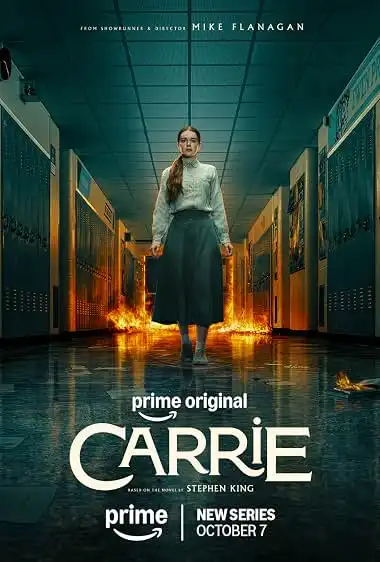
In his mid-20s, an unknown writer from Portland, Maine, began working on his debut novel. He lived in a trailer with his wife and taught high school English. At times, frustration overwhelmed him. He threw the first pages in the trash. Yet his wife dug them out and encouraged him to keep going. He based Carrie on two real girls—one, a classmate who suffered relentless bullying, poverty, and social isolation; the other, a young woman with an incredibly strict, deeply religious mother.
Neither girl escaped her circumstances. In his memoir, Stephen King wrote that the first girl took her own life before he began the novel. He believed the psychological toll of her torment led to her tragic end. The second girl died from a fatal epileptic seizure while living alone. King responded to their pain by giving his protagonist unparalleled telekinetic powers—and the revenge these real girls never had. Eventually, he sold the paperback rights for $400,000. Not long after, Brian De Palma adapted Carrie into a classic horror film in 1976.
My mother owned Stephen King’s entire collection by the time I was born. By age seven, I had read every book. King’s imagination fascinated and frightened me. In addition to Christine, Cujo, Cat’s Eye, and Pet Sematary, I watched Carrie countless times before the IT miniseries aired in 1990. Sequels and remakes soon followed: The Rage: Carrie 2 (1999), the made-for-TV Carrie (2002), and Kimberly Peirce’s 2013 remake with Julianne Moore and Chloë Grace Moretz. My sons favor that version, and so do I. Those two as Carrie and Margaret White seemed unmatched—at least, until Mike Flanagan’s Carrie premiered on Prime Video.
Flanagan’s Carrie Doesn’t Just Retell King’s Fifty-Year-Old Story; Instead, He Rebuilds it With a 21st-Century Sensibility.
Sissy Spacek earned an Academy Award nomination for her portrayal of Carrie White at age 25. Moretz was only 15 when she took on the role. I believed she delivered the best Carrie for a new generation. The 2013 film grossed $84.8 million worldwide on a $30 million budget. As a millennial, I worried Flanagan’s Prime Video series wouldn’t add much to Carrie’s mythos. However, I was wrong.
Mike Flanagan boldly reimagines the source material, giving it fresh pathos and relevance. His creative risks are what set this 2026 adaptation apart. Notably, he draws from the novel’s mock-archival chapters—news clippings, police transcripts, and documents that earlier adaptations mostly ignored.
The New Faces of the Carrie Mythos
Summer H. Howell, just 22, plays Carrie with convincing youthfulness. Samantha Sloyan takes on Margaret White. In this series, mother and daughter begin as allies. With Ralph (Tahmoh Penikett)—Carrie’s father and a military veteran turned conspiracy theorist—we get a fresh perspective on the White family. However, the series keeps Ralph’s and Margaret’s social-withdrawal motivations vague. Instead, it focuses on the family’s unraveling after Ralph’s untimely death. Social services soon discover teenage Carrie. Margaret takes a job at a big-box store—a move that carries pointed social commentary. Meanwhile, Carrie enters high school for the first time.
At Ewen High, she faces new friendships and rivalries. Sue Snell (Siena Agudong) and Chris Hargensen (Alison Thornton) struggle as Chris’s father faces financial troubles. Tina Blake (Josie Totah) seeks social advantage, while Tommy Ross (Joel Oulette) gets caught in the aftermath of Carrie’s infamous locker-room incident. Many students film the event anonymously. Chris uses the opportunity to create a standard social media troll, burner, or hate account (I’m a millennial, it’s gotta be called one of these…) to cyberbully not only Carrie but the entire school. By altering the family structure and exploring urgent contemporary themes, Flanagan’s adaptation brilliantly revitalizes Carrie for a new generation.
The Verdict
Mike Flanagan’s Carrie revives Stephen King’s 1974 classic as a layered, eight-episode meditation on modern isolation and cyberbullying. Rather than simply retell the familiar story, the series frames Carrie’s tragedy as a documentary-style aftermath and expands King’s original vision into a broader universe.
Notably, the show’s narrative unfolds through a distinctly feminine lens. While Flanagan serves as creator, he collaborates with a talented team of female writers and directors—Rebecca Klingel, Justina Ireland, Hiromi Kamata, Axelle Carolyn, and Kyra Sedgwick. Together, they bring a fresh perspective to the material. Kate Siegel stands out as both director of the third episode and as Adelaide, the mysterious narrator linking Carrie to a secret world of women with psychic abilities.
The casting choices add compelling meta-textual layers. Amber Midthunder delivers as gym teacher Rita Desjardin, channeling the protective strength she showed in Prey (2022) to become Carrie’s only true ally. Heather Graham, as Chris’s mother Madison, introduces unseen family pressure and vulnerable layers to Chris’s backstory as the bully. Matthew Lillard—once a rockstar of ‘90s high school and 2000s horror (Hackers is in my Top 5 greatest films, ever; Emmanuel Goldstein aka Cereal Killer! Scream!)—now impresses as Principal Grayle, a powerless yet well-meaning administrator adrift in a sea of teenage cruelty and bureaucracy.
The Newton Brothers’ score, paired with ethereal tracks by Sofia Isella, Katie Garfield, and Wolf Alice, underscores the highs and lows, and loneliness and longing of Carrie’s world.
Flanagan boldly uses a cliffhanger ending to establish a grander mythology. He strategically positions the series for two more seasons he already has planned. By expanding the Carrie White’s mythos into a multi-season structural horizon, Prime Video’s Carrie evolves from a simple horror remake into a compelling, expansive tragedy that leaves audiences eager for more.