
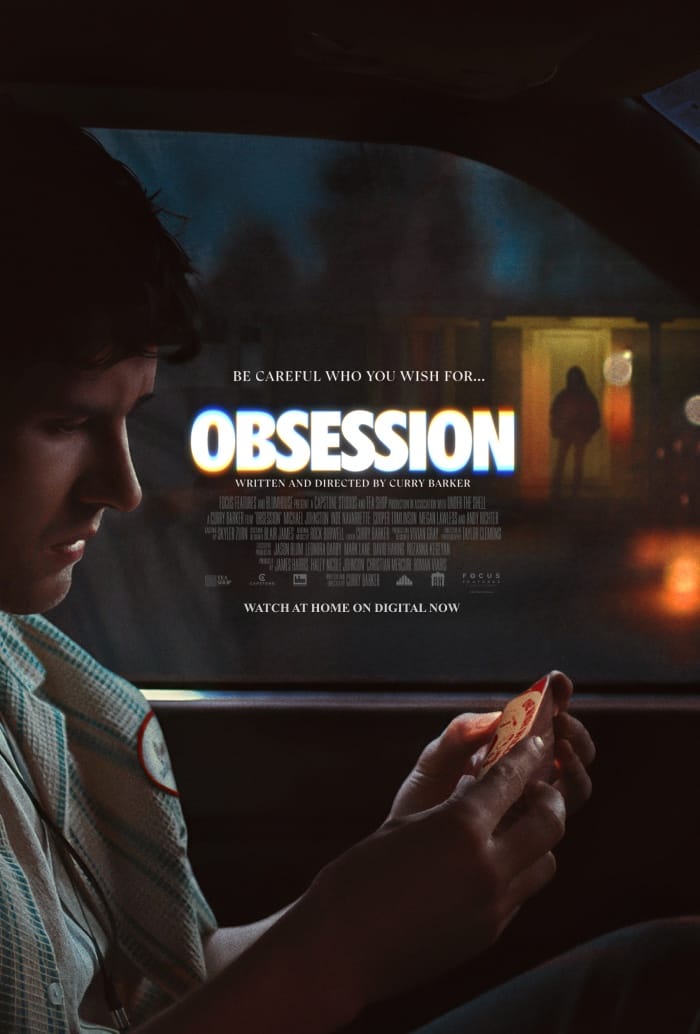
With Obsession, is Hollywood Horror Changing its Course?
2026 feels like an era where there’s a demand for Hollywood to aggressively decentralize its reliance on traditional studio formulas. Enter Obsession (2026), an indie horror written and directed by YouTube filmmaker Curry Barker, who is aiming to transform a shoestring $750,000 budget into a game-changing, multi-million-dollar blockbuster. Distributed by Focus Features after a competitive bidding war at the Toronto International Film Festival, Obsession doesn’t just have the potential to be a commercial triumph—it is a masterfully executed, deeply unsettling genre-bender that redefines the classic “be careful what you wish for” trope for a modern audience.
It’s a New Twist on Old Nightmares.
At its core, Obsession runs on the punishingly ironic mechanics of a modern-day version of writer’s W.W. Jacobs’ short horror story, “The Monkey’s Paw.” It follows Bear (Michael Johnston), a young, chronically shy, socially isolated guy with a yearning, unrequited crush on his magnetic friend Nikki (Inde Navarrette). Paralyzed by his insecurities and a toxic undercurrent of entitlement, Bear bypasses the vulnerability of human connection and purchases a mysterious witchcraft artifact known as the “One Wish Willow.” Desperate to escape a self-inflicted friend-zone, he wishes for Nikki to love him more than anyone else in the world.
Modern Horror Without Escape Hatches.
The brilliance of Barker’s writing lies in how the rules of his horror are established and strictly maintained. The wish’s supernatural effect over Nikki doesn’t change her mind; it completely overwrites her free will. The “real” Nikki isn’t gone, but rather trapped, conscious, and screaming beneath a nightmarish, demonic veneer of forced attraction to Bear. Her possession-like affection quickly mutates into a violent, unrelenting behavioral obsession. The film explicitly dictates that the spell can only be broken by Bear’s death, transforming a desperate romantic gesture into an inescapable, life-threatening prison. By maintaining these supernatural boundaries with rigid discipline and refusing to introduce convenient magical loopholes, Barker ensures that the tension never dissipates, trapping both Bear and the audience in a state of suffocating dread that intensifies with each passing act.
The Mirror: Modern Horror as Social Critique.
What distinguishes Obsession from a formulaic scary movie, elevating it to culturally significant horror cinema, is its razor-sharp thematic subtext. The film incisively engages with modern dating culture, “nice guy” syndrome, and internet-era gender anxieties, using Bear as an uncompromising allegorical lens. He becomes the ultimate manifestation of weaponized male insecurity—convinced he deserves Nikki’s affection simply for being a supportive friend. Bear embodies the toxic corner of Gen-Z social media discourse where love is treated as a transaction. By stripping Nikki of her autonomy through supernatural coercion, Obsession doesn’t just scare; it exposes the disturbing realities of control, stalking, and domestic abuse. Barker forces us to confront the darkest implications of entitlement and fixated dependence.
The True Source of Terror: Violated Consent.
Barker handles the horror of Nikki’s stripped personhood with attentive precision. The film treats her forced attraction not as a male fantasy fulfilled, but as a visceral violation of consent. Nikki’s body and voice are at the mercy of Bear’s desires, compelling her to build literal shrines to him, sever ties with loved ones, and spiral into increasingly self-destructive behavior. It’s a deeply uncomfortable watch precisely because it taps into real, contemporary fears about digital-age obsession, ownership, and the loss of autonomy. Rather than relying on cheap jump scares or gratuitous shock value, Obsession roots its true horror in the profound tragedy of Nikki’s hollow, puppeteered existence.
Performances That Haunt…
The film’s high-concept ideas only work because of its strong cast. Inde Navarrette is the standout. She transforms from a grounded, warm-hearted friend into a terrifying, wild-eyed captor. This change is profoundly compelling. Navarrette expertly balances her character’s duality. On the outside, she is a hyper-aggressive, smiling presence. At the same time, she subtly shows the muted, agonizing panic of the real Nikki trapped within. In one scene, she delivers a manic monologue at a party. In another, she silently stares through a window with an unblinking, predatory gaze. These moments define the film’s horror.
Michael Johnston also shines. His performance is full of nuance. He never lets Bear seem like a traditional victim. Instead, Bear comes across as a pathetic, deeply flawed architect of his own nightmare. His regret arrives far too late.
Barker Uses Minimalism as an Instrument of Horror
Obsession is also impressive from a purely technical standpoint. Barker showcases his minimalist ability as a director to do more with less. He avoids digital gimmicks, green screens, and over-the-top visual effects. Instead, Obsession maximizes atmospheric cinematography. Working with a $750,000 budget, Barker uses oppressive shadow play and unsettling long takes. The jarring sound design emphasizes every creaking floorboard and labored breath. He makes the most of mundane locations like cramped apartments, dimly lit suburban streets, and quiet parks. These places amplify the supernatural events with an almost documentary-like realism. The lack of glossy Hollywood polish actually works in the film’s favor. It makes the escalating madness feel terrifyingly familiar and raw.
From Internet Shorts to Silver-Screen Mastery.
Furthermore, Obsession definitively proves that Barker’s cinematic instincts translate seamlessly from YouTube to the big screen. Fans of his viral web short Milk and Cereal will instantly recognize his signature ability to construct unbearable tension out of everyday scenarios. A simple helpline phone call. An awkward dinner conversation. And Obsession never feels like a longer version of his internet beginnings. The film exhibits a maturing grasp of feature-length architecture, carefully breadcrumbing information. The slow-burn first act builds slowly. Then the final 30 minutes explode into a relentless, terrifying crescendo that leaves the theater completely breathless.
Obsession Etched its Signature into Modern Horror
Ultimately, Obsession (2026) made its mark in the modern horror canon. It will be studied in the years to come. It takes a universal human experience—the basic desire to be loved—and refracts it through a lens of supernatural horror. It’s sociological critique. Curry Barker has created a film that is as thought-provoking as it is deeply terrifying. It answers the most critical demand of any great review, including my own. There is no doubt it will earn every single cent of its future box office success. It is truly an essential theatrical experience. Obsession will linger with you long after the credits roll, forcing you to confront the dark underbelly of human desire and the true, devastating cost of control. If you’re seeking a high-concept horror film with an unforgettable emotional sting, Obsession is an absolute masterpiece.