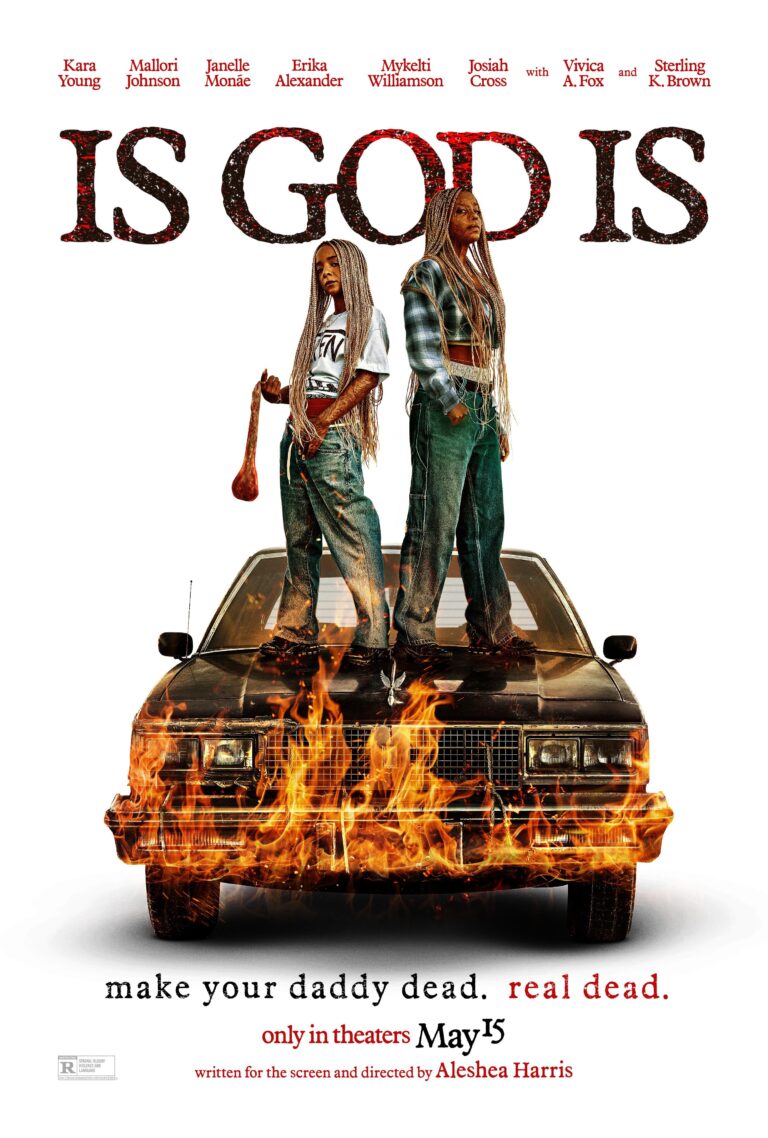
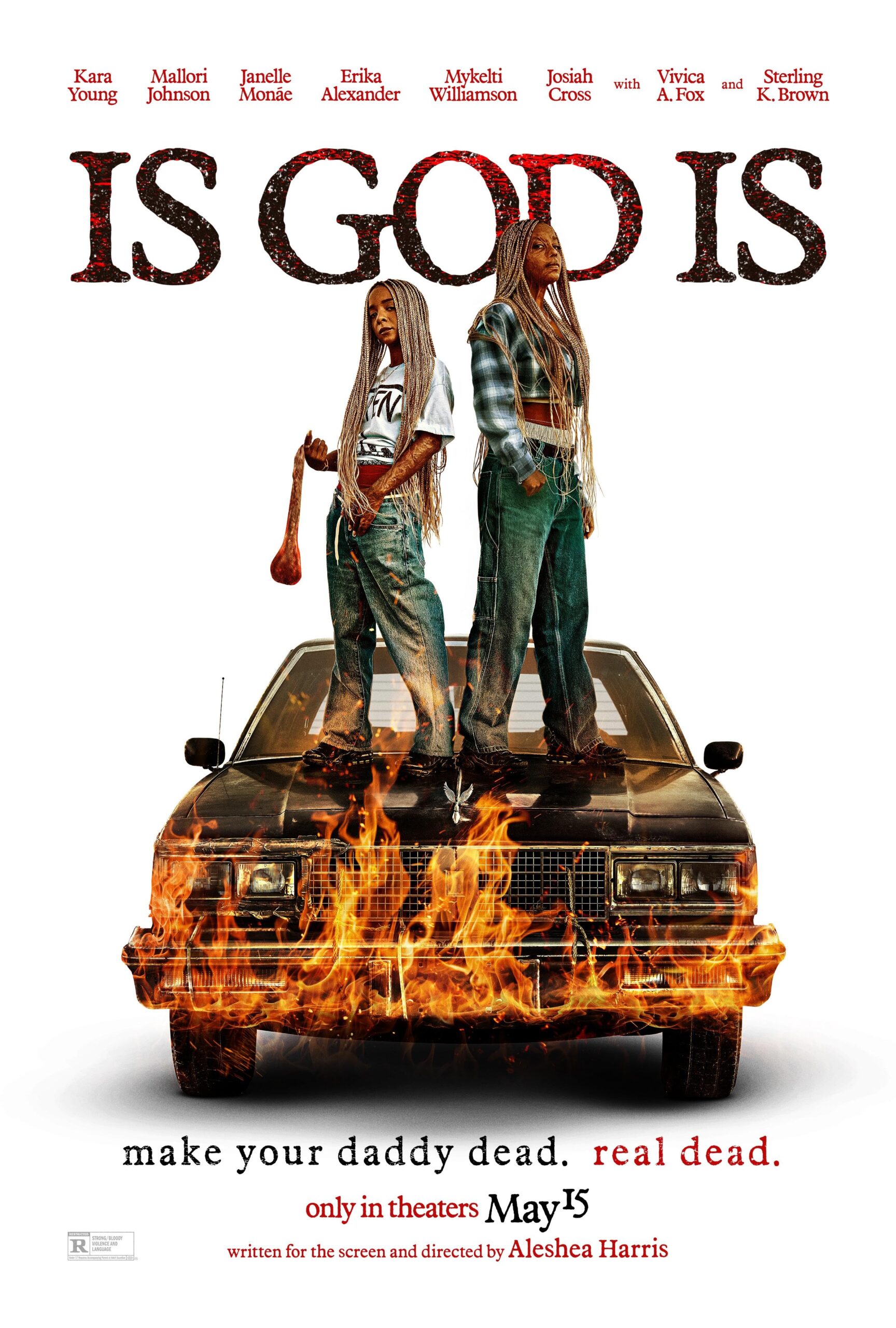
As I sit in an Alamo Drafthouse Cinema, waiting for One Spoon of Chocolate to start, the previews roll. Coming soon: Is God Is (2026). Wait—what? Black women, doing Black women shit—written and directed by a Black woman. Duly noted. I’m there. Then The RZA’s ode to grindhouse cinema plays. Later, I finally catch Is God Is (2026). It’s Black women, doing Black women shit—written and directed by a Black woman. But, like, it’s even more fire than I expected—figuratively and literally.
“Make ‘yo daddy dead. Dead. Dead.”
The story follows two twin sisters on an epic journey for revenge. Their mission comes at the request of “God”—their estranged mother (Vivica A. Fox)—who reaches out to them by letter. When they go to see her, they discover she’s dying from severe burns—the same burns the sisters bear but never knew the origin of. All of their scars come from their father, “Man” (Sterling K. Brown). Their mother’s dying request: “Make ‘yo daddy dead. Dead. Dead.”
It’s adapted from Aleshea Harris’s Obie Award-winning play of the same name. And as she takes on the first-time roll as writer-director in this debut film, you can so tell it’s her first time, in the best way—witnessing the mechanics of her fearless ambition.
The Greek tragedy angle is unmistakable, but it’s got this afropunk aesthetic, too. Toni Morrison defined and applied the term white gaze directly to literature and culture, describing it as the assumption that white culture, people, and readers are the default norm. While W.E.B. Du Bois (and his idea of “double consciousness”) and Frantz Fanon (who described how the white gaze positions Black people) described the symptoms, it was Morrison as a Black woman that diagnosed it through her characters. With Is God Is, Harris applies Morrison’s mastery of a character’s raw, Black interiority to her movie and it’s beautiful to see on a Hollywood screen.
There’s even a bit of spaghetti western in there, and Harris wraps all these ambitions into a grindhouse package. Like One Spoon of Chocolate, Is God Is is undeniably an ode to grindhouse cinema. It’s worth noting, however, that the budget was reportedly somewhere in the tens of millions.
The “What” of Is God Is
The best grindhouse and exploitation films have pithy, sensational, lurid, and over-the-top titles. They immediately signal to audiences exactly what kind of sleazy, violent, or campy fun they’re in for. While the name partly comes from the scrappy grind of a shoestring budget, many of these films are actually highbrow in their own way. Faster, Pussycat! Kill! Kill! (1965), directed by Russ Meyer, set the ultimate blueprint for aggressive, high-energy exploitation naming. These titles highlight the sheer psychological weight of things so basic that we often take them for granted.
In a conversation the sisters say, “She made us, so…She is kinda like God. And we ain’t finna leave God hanging, right?” I interpret Is God Is to essentially ask, “Is God real? Is God actually what God is?” We’re watching two sisters with fragmented identities, each bearing the unique trauma of being disfigured, searching for answers. In their eyes, the mother they’d wondered about their entire lives—and finally come to know—is God.
Meet “God’s” Followers
Racine (Kara Young) and Anaia (Mallori Johnson) survived foster care in ways you and I can’t imagine. Because of this, Racine is mouthy, assertive, high-energy, and fiercely protective. Her childhood burn scars are limited to her arm, neck, and back, so she passes through society with less immediate physical scrutiny than her sister. She channels her trauma outward into an armored, aggressive exterior and readily adopts the role of the enforcer. Young, a back-to-back Tony Award winner, emotes this lazer-point precision.
Anaia is introverted, deeply emotional, sensitive, and hesitant. Her burn scars cover her face, making her trauma visible to everyone she encounters, which has caused her to live a more retreating, insular life. She carries her pain inward, processing the world with heavy skepticism and emotional caution.
As their cross-country odyssey descends deeper into the American South and they encounter their father’s Satan-like path of destruction, Racine’s clean, righteous lines of her vengeance begin to blur into amoral chaos. At one point, the stripmall defense lawyer Chuck Hall (Mykelti Williamson)—who’d won Man’s case about setting them and mother fire—writes to Racine on a whiteboard that she’s a lot like her father and has his eyes. Man preemptively cut out Hall’s tongue so he could never speak again, specifically about what Man got away with. Deep, right?
But as Anaia is repeatedly pushed to her limits and forced to confront the legacy of her father’s irreversible effect on those around him, her buried, molten grief hardens into terrifying, unrepentant fury. Johnson’s portrayal of Anaia’s visceral, burgeoning, Black mother-like qualities is rendered with such grace that she deserves awards of her own.
The Sophistication in Aleshea Harris’s Is God Is Characters Many Overlook
Besides Man clearly being Satan in the flesh, Harris’s characters are essentially asking: Is God what God actually is? Deep in the South, they meet an influential preacher named Divine (Erika Alexander), who represents James 3:1. The Bible states that teachers face a much stricter judgment because they can mislead others; ignorance or self-delusion does not excuse the harm caused by false teaching. Divine knew what Man had done but deluded herself into thinking she could “fix” him. In reality, Man manipulated her and left her pregnant with a son, Ezekiel (Josiah Cross), whom he never stayed around to meet.
Later in the film, Ezekiel tracks down his half-sisters, honoring both his mother and father by destroying their car—stopping them from reaching Man. In the Bible, Ezekiel initially warned the people of Judah that Jerusalem and its temple would be destroyed because they turned away from God. Before Ezekiel reaches his sisters, the two are arguing about Rancine changing. The overall theme of the film’s second act is “blind guides.” Jesus describes religious leaders who fail to see their own spiritual blindness as blind, warning that if a blind person leads other blind people, all will fall into a pit of fire (Matthew 15:14).
Janelle Monáe plays Angie, Man’s trophy wife and ideal of perfection. She embodies the superficial “perfect life” Man wanted after a lifetime of unaccountable destruction. When the twins arrive at her perfect home, Angie is forced to reckon with the monster she chose to marry. The twins are carrying out “God’s” will. Angie’s arc serves as a critique of those who protect abusers in exchange for security; her polished veneer cannot survive the wrath of incoming, raw Black female rage.
What Is God Is is not
Ultimately, it’s not about bashing a Black man or declaring that God is a Black woman; it’s about accountability—even for “God.” At first glance, many may see it as a satisfying revenge fantasy, but it’s actually about how trauma reproduces itself. Ruby (“God”) doesn’t just ask her daughters to deliver justice; she emotionally sacrifices them because she herself evaded accountability. In passing her burden of vengeance onto her children, she forces them to consume their own lives in fire and blood. The ultimate tragedy of Is God Is (2026) is that enforcing this legacy requires Racine and Anaia to harden themselves, ensuring that Man’s—Satan in the flesh’s—violent legacy irreversibly reshapes them. Remember, the lawyer said he saw their father’s look in Racine’s eyes.
Harris has explicitly stated in interviews that Western society dictates Black women must always suppress their anger and present themselves as composed. Because society allowed Man—the physical manifestation of “God’s” fallen angel—to outrun his crimes, the sisters become the physical manifestation of an overdue cosmic receipt. Is God Is frames their violence not as senseless cruelty, but as the only remaining avenue to force Satan—a metaphor for human, “Man”—to look at what he created.
The Verdict
Is God Is (2026) seamlessly fuses the decaying rot of classic Southern Gothic tales with Greek tragedy. It expertly blends that slow-burn style with blood-soaked, hyper-stylized grindhouse grit and vengeance. Brilliant, carefully curated music choices—from Death Grips to Prince to Doechii—masterfully anchor its volatile emotional landscape. The creative engine of Is God Is, is unmistakably Black women, doing Black women shit—written and directed by a Black woman, and even co-produced by Tessa Thompson’s Viva Maude. While editors Jay Rabinowitz and Blair McClendon and cinematographer Alexander Dynan contribute their expert craft, and Freyja Bardell’s production design (notably seen in Kendrick Lamar’s “Not Like Us” video) shapes the film’s look, the film’s driving force is rooted in Black women’s perspective, voice, and rage. It’s a thorougly enjoyable watch and easily one of my favorite films of 2026.