
If I Go Will They Miss Me Refuses to Let the Black American Experience Be Erased from the Western Canon.
As women of color—especially Black women—face unique, often unseen challenges of racism and sexism, Black men have their own. Ours are more systemic and institutional. From slavery to wage gaps, it’s nearly impossible to fulfill our cultural roles as Black fathers, husbands, brothers, and homies. But this is America, the “land of opportunity.” Our very real generational barriers have become others people’s background noise—“just the way things are.” No one cares or has time to hear your problems. You make a way, or you don’t. For a Black boy, watching his father tackle these impossibilities makes that man a god.
The Power, Responsibility, and Danger of Mythmaking in Watts
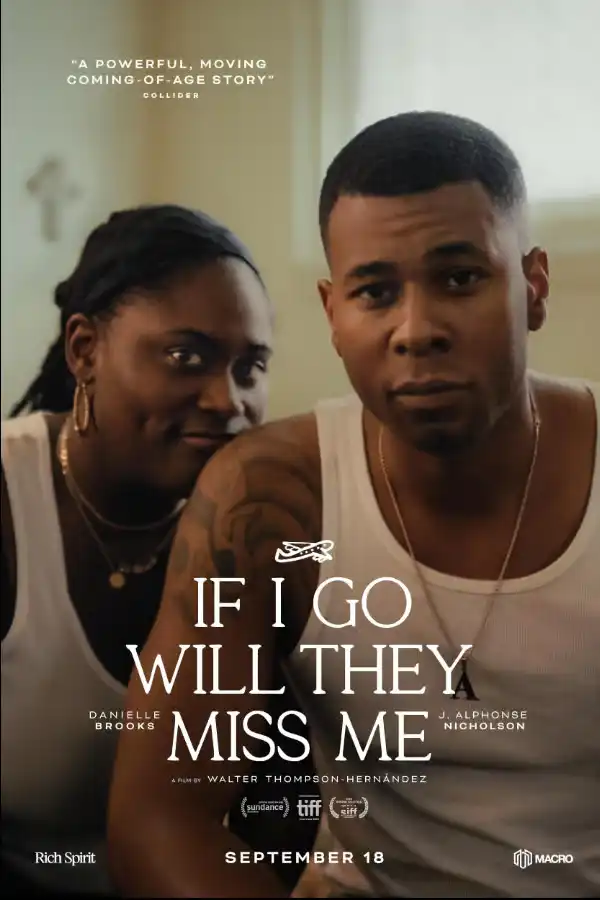
If I Go Will They Miss Me, written and directed by Walter Thompson-Hernández, explores this view through 12-year-old Lil Ant (Bodhi Dell). He tries to connect with his father, Big Ant (J. Alphonse Nicholson), after his dad gets out of prison. Most of what Lil Ant knows about his dad comes from his mother, Lozita (Danielle Brooks). She shares stories with omissions and half-truths—myths. As a result, through Lil Ant’s mind, Big Ant becomes Poseidon, while Lil Ant sees himself as Pegasus. Yet these mythic expectations can intimidate an institutionalized Black father.
Fathers, Cycles, and Who Gets to Belong in the Western Canon
In 2020, a Delta Air Lines plane dumped jet fuel over Watts, contaminating schools and neighborhoods. Thompson-Hernández grew up under the LAX flight path. He breathed those fumes yet dreamed about the planes’ destinations. This experience created a deep connection to the catastrophe and its effect on children of color. Ultimately, the incident inspired his original 2022 short film. Its Sundance win helped him expand the project into this feature-length film.
If I Go Will They Miss Me belongs in the Western canon as culturally significant American art. However, since Ancient Greece and Rome, Europeans have stolen the art of those they conquered. This theft shaped Western civilization’s Eurocentric dominance and the idea of “neutrality.” That neutrality, however, remains a myth. During the age of empire, Europeans took African art and displayed it in cities like London, Paris, and Berlin. Over time, this dominance dictated how Black artistic expression entered the canon. Even today, these same forces shape our “classic” literature, philosophy, art, and music, still deciding whose stories we hear.
The Profound Effects of Environmental Racism and Artistic Gatekeeping Intertwining
You might wonder: what does this have to do with the movie? In fact, this is how environmental racism goes unchallenged—invisible to those who can opt out. If you’re white or non-Black, you can disengage, as Peggy McIntosh describes in her “invisible knapsack” of white privilege. If you’re Black and asking, often you’re doing so, faking intellectual depth you may not possess. Percival Everett’s Erasure exposes how this “neutrality” works against Black artistic expression. Because of this, Black American creatives respond by flexing deep knowledge of Greek and Roman antiquity.
Like Everett’s character Monk, who creates a stereotypical Black pseudonym to expose it, Thompson-Hernández uses “Big Ant” to show these effects on the Black family. These men get trapped in cycles of systemic racism. Survival often produces emotional detachment, fatherless broken Black male interiority, and ultimately incarceration and absence as the intended by-product. Yet Lil Ant, creative and perceptive, sees his dad’s struggle to “find his way back”—a journey as epic as Odysseus’s.
The Power of Acting at the Intersection of Artistry and Meaning
J. Alphonse Nicholson elevates Thompson-Hernández’s vision to an epic, highlighting modern, systemic challenges of the Black American family. The institutionalized rarely have the courage for all types of cool sh*t like sketches of “Flying African” art and proudly hanging it on their project bedroom walls, as Lil Ant does. Or imagining their father as Odysseus. In a moving scene, Big Ant tears down Lil Ant’s artwork and school project—a life-sized Pegasus and his wings—and throws it away.
When Lil Ant discovers his mother saved it from the trash, he demands to know why. He confronts his father, whom he’d held in mythic regard. Despite his son’s grace, Big Ant can’t express his longing to do better or why he did it. In a fit of frustration, he smacks Lil Ant.
Thompson-Hernández captures this brutality with expert detail. Throughout the film, mirrors stand in the front yards of the projects. Men watch themselves lift weights—an authentic Nickerson Gardens custom. These men sculpt their bodies like warriors or gods. However, when their children confront them—who already see them as gods—they cannot face their own reflection. The Compton horse stable Big Ant works at is the only place he looks at himself in the mirror. These visual sequences are intentional. The acting and directing—they are art, an intellectual flex of classical Western comprehension.
Nickerson Gardens Isn’t Just a Backdrop—And Lozita Isn’t Just a Mother There
Thompson-Hernández, a journalist-turned-filmmaker of Black and Mexican descent, set out to subvert standard portrayals of Nickerson Gardens. In cinema, public housing often gets reduced to settings for violence and trauma. Nickerson Gardens, the film’s main setting, has a deep cultural history. West Coast Rap All-Stars, O.F.T.B., and Kendrick Lamar filmed music videos there. Rappers Jay Rock and Killa Twan have ties to the area—TDE as well. You’ll also see it in movies and TV shows like Training Day and FX’s Snowfall.
By filming at Nickerson Gardens, Thompson-Hernández highlights the beauty, humanity, and wonder of everyday life there. Danielle Brooks’s Lozita brings nuance to the film’s mothers. She shows what it’s like to navigate spaces fathers and sons often overlook or take for granted. Lil Ant, obsessed with airplanes and Greek mythology, sees his mother as Medusa. In Greek myth, Medusa is the mother of Pegasus. For Lil Ant, the snakes in her hair are beautiful—not terrifying—turning her into the protective source of his own ability to fly.
Brooks portrays a nurse who’s been with Big Ant since high school. Even then, he was in and out of prison. Lozita stays with Big Ant out of duty more than love. That often means protecting Lil Ant’s fragile view of his father. After Big Ant’s slap, she tells Lil Ant his father is a “work in progress.”
Her son needs his father. Deep down, she knows she deserves more. In a scene with her sister, Jenn (Bre-Z), Jenn urges Lozita to leave Big Ant and start a new life with her children. When Lozita finally finds the courage, Lil Ant reacts in complex ways. Because of the film’s mastery of Greek mythology, Thompson-Hernández’s Pegasus metaphor stays with you long after the credits roll.
The Verdict
While the film’s deliberate pacing and abrupt ending may challenge some viewers, its stunning cinematography and poetic lens deliver a moving portrait of the Black American experience. Big Ant’s true homie JJ (Myles Bullock) grounds Lil Ant’s imaginative escape in realism. JJ acts as a reality check, reminding Big Ant of his duty to protect his child’s innocence. In the end, this film is powerful—one that deserves a place in modern American cinematic classics. And the Western canon, of course.