Defending the Innocence Lost in the Regan Era
Masters of the Universe (2026) came out for early access screenings on Wednesday, June 3, 2026. Where I’m from, people say “pause” after a line like that. If my tongue-in-cheek lead already has you ready to debate (pause), this movie might not be your vibe. The film doesn’t take itself too seriously—even choosing to come out during Pride Month. These kinds of double entendres just keep coming (pause). Trust me, there’s plenty more where that came from, too (look, let me get through this review).
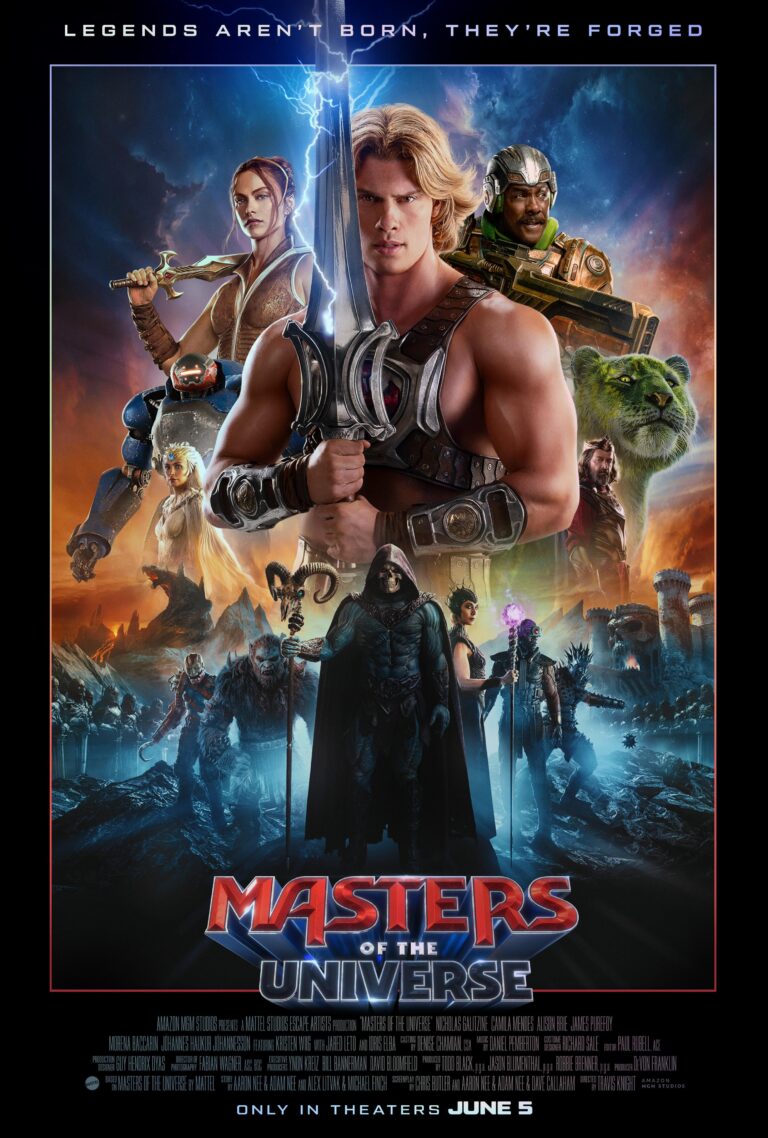
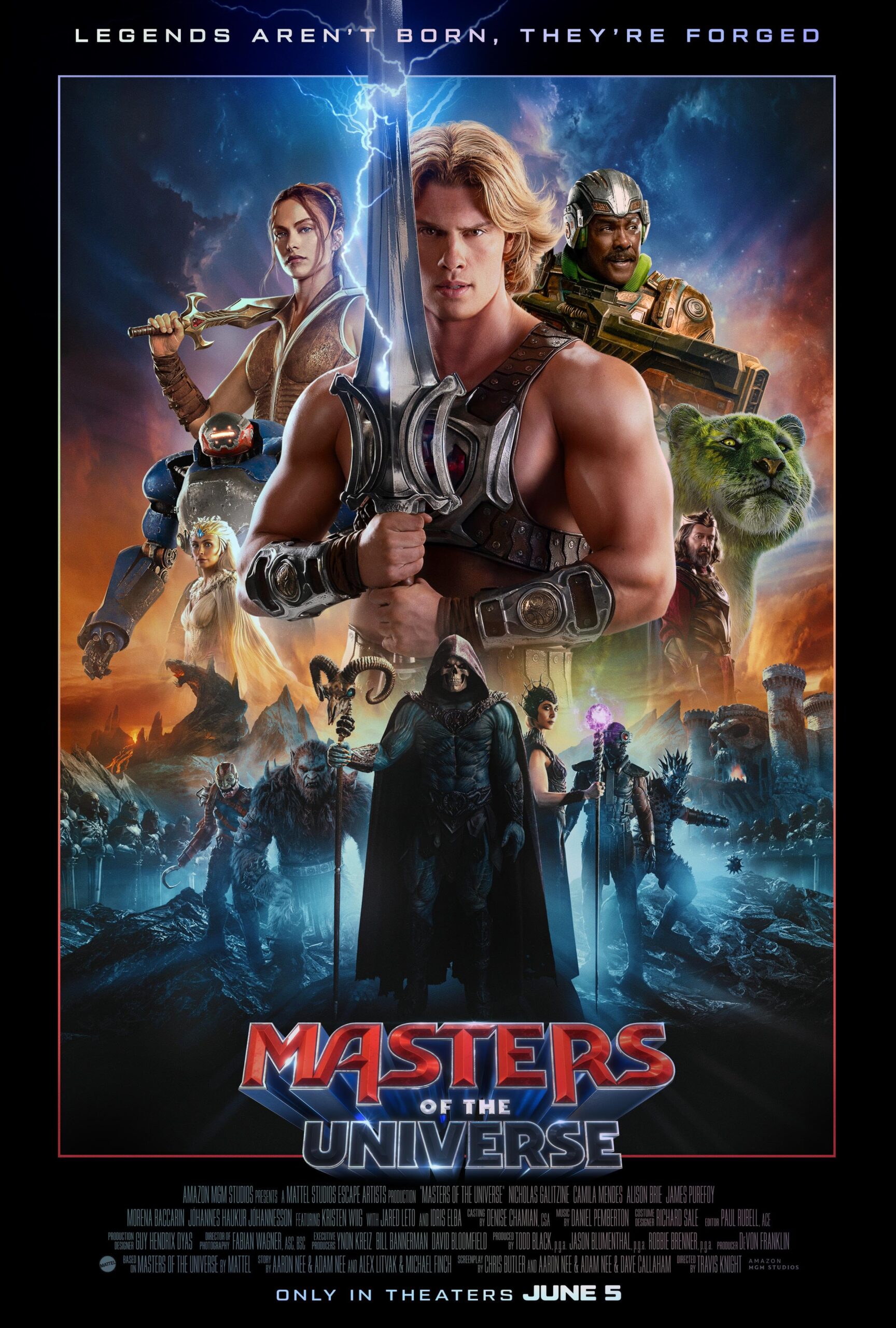
The story follows Adam Glenn, portrayed by Nicholas Galitzine, prince of Eternia—a kingdom in another dimension. As a child, he lost his family and home to a tyrant’s siege and has spent the last fifteen years in our world, specifically in Oklahoma City. People don’t believe his fantastical stories about Eternia or his claim to be the sole protector of the Sword of Power. On a date, he admits he lost the sword while barely escaping the attack—prompting the young woman to get up and leave. Even at his HR job, the film makes sure we see Adam’s desk plate, which pointedly displays his pronouns as “He/Him”—but he just doesn’t know what that embodies anymore. To everyone, he seems a gentle, self-conscious underachiever—a dork.
Directed by Travis Knight and shaped by several writers, the film explores how nostalgia can be a form of childhood displacement. Adam’s quest isn’t just about reclaiming his rightful throne. Masters of the Universe tells the story of a boy torn from his home, forced to grow up in a world that dismisses his memories as delusions, and ultimately challenged to define himself as he—a man. “He-Man.”
Barbie, Battle Cats, and the Business of Nostalgia
As a Black kid from New York City, by the time I was four or five, I already had fond memories of seeing someone get punched in the face or chest—“thought he was He-Man.” Everyone watched the cartoon: a blond-haired, blue-eyed white guy in a pink shirt who rode a green tiger. There was some representation for me—Galaxy Rangers had a Black character, and I loved the intro. The name of the toy company meant nothing to us. Hasbro made Transformers. Bandai and Matchbox made my Voltron toys. Later, Playmates Toys made Ninja Turtles. My He-Man toys were from Mattel.
Back in the days of Reaganomics-era toy manufacturing, relying on a single named protagonist was risky. If kids didn’t like He-Man, the whole toy line could collapse—hence, “Masters of the Universe.” Cha-ching. He-Man and the Masters of the Universe became one of the highest-rated children’s programs of the ’80s. For a while, the toys were Mattel’s hottest line—even outselling Barbie. This all-types-of-cool-sh*t sidequest is here to highlight the nearly twenty years of development hell behind this film. The 1987 adaptation starring Swedish movie star Dolph Lundgren faced similar challenges.
Power, Parody, and Putting Down the Armor
Behind this new film, Mattel is rumored to have a $170 million, high-stakes strategy to build a cinematic universe around Masters of the Universe (2026)—and other nostalgic toy properties after Barbie’s success. This movie—its production, its star-studded cast—serves a dual purpose: box-office competitor and global merchandising powerhouse. Imagine the gritty, serious sword-and-sorcery mythology other studios might have tried before this Amazon MGM Studios version. How far we’ve come (pause) with identity politics. Going with unapologetic weirdness, meta-commentary, and subversion of ’80s hyper alpha-male tropes was the better battle plan.
During the film’s first act on Earth, Adam and Teela (Camila Mendes) are chased by a monstrous creature—until an Amazon delivery truck suddenly barrels in, running the monster over and saving them. It’s a hilarious, self-aware meta-joke that perfectly captures how mundane modern reality can bulldoze the absurdity of ’80s cartoon logic. Masters of the Universe places a hand on the shoulder of aging Gen Xers and Xennials—those who once ran around backyards or city stoops with toy Swords of Power, or punched friends in the chest, “thought he was He-Man”—and gently assures them: it’s okay to put down the armor.
A Musclebound Hero With a Relatable Core
Knight’s direction shines in scenes like Adam’s physical transformation. When Galitzine finally raises the blade and utters, “By the power of Grayskull,” the moment is both epic and inherently funny. Adam becomes He-Man, his body morphing into an impossible physique, but his anxious, insecure mind is still trapped inside. He’s dazzled—if not outright embarrassed—by his own sudden hyper-masculinity.
Galitzine’s comedic, physical acting grounds the role. Instead of playing He-Man as a composed, stoic hero, he leans into the awkwardness of a young man grappling with an identity—and a legacy of masculine valor—he never asked for. In a spectacular, bloodless battle against cybernetic minions like Sam C. Wilson’s Trap Jaw, He-Man cracks jokes and even fumbles his warrior poses.
Passing that Sword (Pause): Generational Change and Modern Heroism
A standout moment arrives with Dolph Lundgren’s cameo as an eccentric gym guru, “Macho-Man.” The name nods to old-school macho tropes, yet Lundgren’s gentle, empathetic mentorship subverts expectations. When he tells Adam, “You’re in my spot,” it serves as meta-commentary on generational change—the need to step aside and let a new, more emotionally nuanced hero take the lead. Lundgren offers Adam sage advice—not about lifting weights, but about finding validation from within rather than seeking it in how others perceive your “front.” It’s just a façade.
He closes the scene with his iconic 1987 catchphrase, “good journey,” blessing this modern, sensitive He-Man and reinforcing that heroism must evolve with the times. Adam internalizes this wisdom, later repeating Lundgren’s words about stripping away “the façade” to inspire Eternia’s demoralized citizens. The cameo foreshadows that true power isn’t in a magical sword or massive biceps—it’s in the courage to be vulnerable and trust your community. When Adam tries to rally his ragtag resistance with a corporate “teamwork seminar” instead of a war cry, the film reaches its satirical peak, making it clear that real strength lies not in brute force, but in emotional honesty and collective unity.
Laughs and Legacy: The Evolving Masters of the Universe
Idris Elba plays Duncan, also known as Man-at-Arms. The film reimagines this character, originally white, as Black and as Teela’s father. Kristen Wiig voices Roboto, who is now a gender-flipped, Class-4 combat droid. Duncan builds and reprograms Roboto to serve as a companion. The film’s comedy shines in moments like Adam reminding everyone, “Class-4s are the deadliest super soldiers ever engineered. Just one of these bots is worth about fifteen soldiers.” When the team is locked away as captives, Roboto casually strolls through a massive metal door. The moment is like watching someone walk through the strip curtains in the refrigerated section of a supermarket. This perfectly captures the film’s courage to poke fun at the 1980s absurdity of assumed roles.
Jon Xue Zhang plays “Ram Man,” a nickname Adam gave him as a kid because of his bulky, spring-legged frame and battering-ram helmet. Jóhannes Haukur Jóhannesson appears as Malcolm, better known as “Fisto.” The score, co-composed by Daniel Pemberton and Queen guitarist Brian May, captures the excess of the 1980s. Electric guitar riffs shine on tracks like “Electrica.” Meanwhile, The Darkness co-writes and performs the title theme. This fresh musical energy lifts even the film’s most outrageous moments. For example, the heroes shout, “Yeah! Let’s fist some bad guys! Give them head, Ram Man!” Yet the film’s style gives these jokes a surprising sense of respectability as art.
Jared Leto’s Skeletor sheds all artistic pretension. He strikes a balance between real menace and a goofy, narcissistic drama king stuck in a Shakespearean tragedy. To create the character, he wears a detailed muscle suit on set. Later, his face is replaced in post-production with a digital CGI skull. Leto uses grand, exaggerated gestures and melodramatic sighs. These choices show the agony of a villain surrounded by incompetent minions. While some CGI effects and fight scenes lack polish, the team took special care with Skeletor. Their work brings this classic villain, teeth-chattering and all, forty years into the future.
Slight Drawbacks
As a kid, Cringer—Adam’s lazy, cowardly green pet tiger—was always my favorite. And not just because he transforms into Battle Cat, the fierce, armored tiger who serves as He-Man’s brave steed. Orko’s appearance was a bonus. The floating, heroic court magician and comic relief of the franchise, Orko was originally created by Filmation for the 1983 animated series to appeal to younger audiences, eventually becoming so popular that Mattel quickly added him to the action figure line. I only knew He-Man through the era of reruns, but Cringer and Orko were honestly my two favorite side characters. The movie definitely could’ve benefited from more of both.
The Verdict
Why does Masters of the Universe (2026) work so well? And what does it mean for Mattel’s high-stakes strategy? The answer is simple. The film embraces the silliness of its roots, but updates its heart and humor for an audience that has grown up. Today’s viewers are older and more complicated. This movie winks at the Comic Con crowd. It understands adult collectors who crave nostalgia with a twist. It also delivers a toy chest full of new jokes and clever references. Mattel’s rumored toy line is more than a cash grab. It shows that pop culture has matured. The fans have grown up too. Many who once bashed action figures together in their childhood bedrooms now look for deeper meaning and fun in these stories.
Wiig’s Roboto, actually delivers one of the best lines in the entire film. “Existence is a series of absurdities leading to infinite nothingness.”
What makes this adaptation work is its willingness to treat identity politics as an honest part of the story, not just a checklist. The film is irreverent, but never mean-spirited. Its double entendres, gender flips, and race swaps are handled with respect and a playful sense of fun. Masters of the Universe embraces its ridiculousness. In doing so, it validates every “dork,” outsider, or kid who ever dreamed of wielding a magical sword. This isn’t just another dose of nostalgia. The film invites you to laugh at its absurd moments, to love its heart, and maybe even see yourself in its cosmic chaos. In a reality flooded with forced reboots and cynical cash-ins, Masters of the Universe stands apart. It actually earns its legend.