
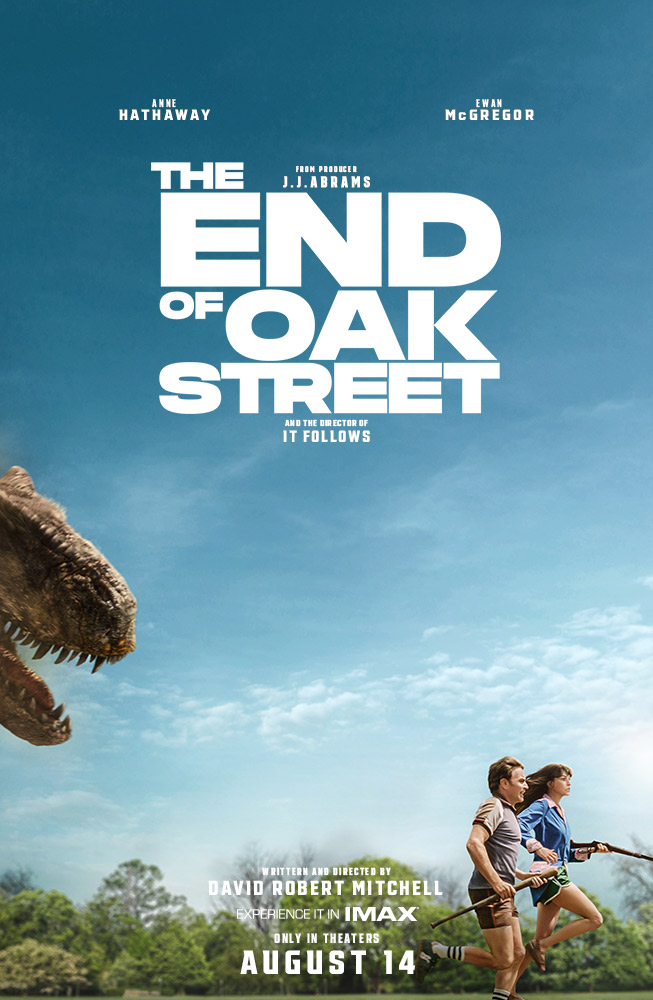
David Robert Mitchell is easily one of my favorite writer-directors. If you’ve seen Under the Silver Lake, you know why. On the surface, it’s an ode to Hollywood noir—an American black comedy thriller. Beneath that, it’s about the human need to find deeper, secret meaning in our bleak, cookie-cutter perception of a commercialized world.
His latest film, The End of Oak Street (2026), is a study of the 1980s, an era when a picture-perfect, picket-fence sheen defined suburbia and the middle class. That image ruled the world. But in the process, people forgot who they truly wanted to be in pursuit of maintaining that commercial facade. As we recognize today, striving for that illusion only sharpened the teeth of indifference that ultimately tore those families apart.
That’s what happens to the Platt family, led by parents Greg and Denise (Ewan McGregor and Anne Hathaway). Greg loses his job and secretly delivers pizzas to make ends meet. Denise is an aspiring writer who covertly creates fiction that mirrors her own marital frustrations and her hidden desire to leave her family behind. In classic 1980s movie fashion, these tensions begin to affect their children, Audrey and Brian (Maisy Stella and Christian Convery). Then, a bizarre temporal event transports their Oak Street subdivision to a savage, prehistoric jungle.
Jurassic Park with Spielberg’s Exploration of Familial Complexity Meets Jaws and Goonies and Stranger Things
Michael Giacchino’s score does that thing—the thing I described earlier this summer in my review of Spielberg’s latest film, Disclosure Day (2026). That Robert Zemeckis and John Hughes thing: the unmistakable 80s sci-fi adventure film’s music. Driving ostinatos? Maximalist optimism? Those fast, repeating string patterns that create a sense of urgency—the second hand of a clock thundering like an orchestral bass drum. Time ticks, unapologetically. Bright, major-key brass fanfares and soaring string melodies evoke triumph and wonder. DeLoreans. Aliens on your BMX handlebars soaring across a large-moon sky. Psychokinetic, Eggo-loving kids. Pure Amblin-inspired nostalgia.
I could’ve just said Amblin-inspired, right? We could’ve also called Back to Future, “Back to the Present.” See what literalism would’ve done to 1980s nostalgia? David Robert Mitchell weaves in this kind of existential absurdism. Instead of the sheer nihilism of “nothing matters,” his characters are always desperately searching for deep answers beneath the veneer of America’s superficial capitalist nature—a quest that often leads to borderline insanity and literal dead ends. The Platts’ neighborhood is uprooted into a time-traveling orb, The Terminator style. The end of Oak Street, and the entire circumference of the neighborhood, becomes a steep canyon, cutting them off from the rest of humanity. At one point, Denise says, “I’m just trying to figure out the least scary way to handle this.”
If You Already Don’t, You’ll Get to Know David Robert Mitchell as a Writer-Director, With This Movie.
Mitchell wrote and directed it, J.J. Abrams, Hannah Minghella, Jon Cohen, Matt Jackson and Tommy Harper produced it. Its executive producers are Chris Bender, Jake Weiner, Joanne Lee and Leeann Stonebreaker. If you’re familiar with the behind-the-scenes world of movie making, you’ll appreciate seeing Mitchell’s granted artistic freedom pay off.
We’re introduced to Audrey, for instance, as a Carl Sagan-obsessed, astrophysisist in the making. She’s the one who uses Carl Sagan’s books to explain the glowing spherical portals and anomalies. If you’re into all types of cool sh*t, like I am, his book, Cosmos, touches on oak trees: “An oak tree and I are made of the same stuff. If you go far enough back, we have a common ancestor.” The book explores 15 billion years of cosmic evolution, bridging the gap between science, human history, and philosophy.
With this in mind, many viewers may not catch the son Brian’s inverted 80s character arc. He threw a stick into the spokes of a kid named Charles Tucker’s bike and broke his arm, leading to tension and retaliation from Charles’s older brother, Kaden. Brian doesn’t go anywhere without his bow and arrow which reinforces his bravado. It’s almost like his security blanket. Tribalism. He’s a young hunter, and he also has a crush on his neighbor, his “gatherer,” named Jeannette played by Jordan Alexa Davis. However, later in the film, we see an implied, subtle chemistry between Jeannette and Audrey.
You may think you’re watching an absurd, dinosaur flick, but like Under the Silver Lake, there’s tons of elevated subtext like this. While The End of Oak Street has a plot that reads as a simple, easily marketable pitch to studio executives it functions as an allegory for Mitchell’s high-brow audience.
The Evolution of “Man”
It starts with the family dog—man’s best friend. Mitchell uses Starbuck’s disappearance to drive the plot forward. While the Platts treat the search as an urgent, life-or-death crisis, it quickly becomes clear that Starbuck—Mitchell’s nod to 80s sci-fi series, Battlestar Galactica, not Moby Dick—possesses sharp survival instincts and is never in real danger. The true imminent threat is the rapid sociological breakdown of the family unit, which was fracturing long before Starbuck ran away.
The family dog’s absence strips away the polite, superficial layers of daily routine, forcing deep-seated resentments, class anxieties, and isolation to the surface. Brian’s fixation on saving Starbuck gives the family a tangible, shared purpose—a desperate coping mechanism to avoid confronting their failing marriage and emotional disconnection. The ultimate irony is that the resilient animal easily navigates his changing world; it is the Platts who couldn’t.
Mitchell dedicates The End of Oak Street to his father, Robert Allen Mitchell, who passed away in 2024. His father’s lifelong love for dinosaurs and classic monster movies served as a personal inspiration for the film. Greg’s reduction to delivering pizzas in secret is a powerful lens through which to explore expectation and disappointment, as well as the modern perception of what a husband and father should be. The movie highlights the suffocating pressure of 1980s masculine expectations.
Sometimes, it’s as simple as no-questions-asked sacrifice. You just do it. This becomes clear when the once-disillusioned Denise recognizes that Greg had always made such sacrifices—but it took his ultimate act for her to realize it. Earlier in the film, she implied, while arguing with a neighbor, that Greg was a coward. Only when she briefly finds herself in his shoes does she truly understand how much the family took him for granted.
The Verdict
Like Back to the Future, which literally means “Back to the Present,” we could nitpick that humans and dinosaurs never coexisted. Some may get pedantic about Mitchell being fluent in Sagan yet mixing prehistoric animals from different eras. Even our coexistence with them. But that zaps the fun out of the stuff. It also leaves the absurdities of life unexamined, and that’s a life not worth living. Like all those 80s movies and shows, these films became nostalgic touchstones because they dared to challenge the absurdity of literalism.
After surviving the time loop and dinosaur insanity, Denise writes a book documenting everything her family lived through. She titles it The End of Oak Street—meaning the movie itself ends with a character creating the very piece of media you’ve just watched. Mitchell masterfully interacts with the history of cinema, intentionally crafting a film as an explicit homage to 1980s Steven Spielberg blockbusters, heavily playing with the tropes and visual language of films like E.T., Poltergeist, and Jurassic Park. Like Under the Silver Lake, he’s created another piece of underrated, metatextual art.
The End of Oak Street’s behind-the-camera team includes director of photography Michael Gioulakis, production designer Maya Shimoguchi, editor John Axelrad, and costume designer Erin Benach. Mitchell takes an accessible genre—a sci-fi thriller rooted in 80s Amblin middle-class “normalcy”—and uses it to explore humanity’s evolution over the past forty years, opting for artistic depth over cheap nostalgic thrills. Warner Bros. Pictures presents a Bad Robot production, a Jackson Pictures production: The End of Oak Street. It’s a film that’s definitely worth experiencing in theaters.